B-WEL

It’s been a highly hectic couple of days. I’ve taken on an urgent job with the business, which kept me away from this blog yesterday. And last night saw the second Ashlyns Lecture. We were very lucky that the lucid and stirring Polly Higgins came to Berkhamsted. She may just have started something.

After setting up a vague horse-shoe of blue plastic chairs at Ashlyns School in the early evening, delivering my co-chair-re-arranger Trevor home, rushing around printing off the list of pre-bookees, I got back to the venue to find our star speaker was already enjoying a plate of the most delicious vegetarian food I’ve ever tasted. I didn’t eat Polly’s, no, I had a plate of my own. Thank you Parul, look forward to seeing you on Masterchef one day.

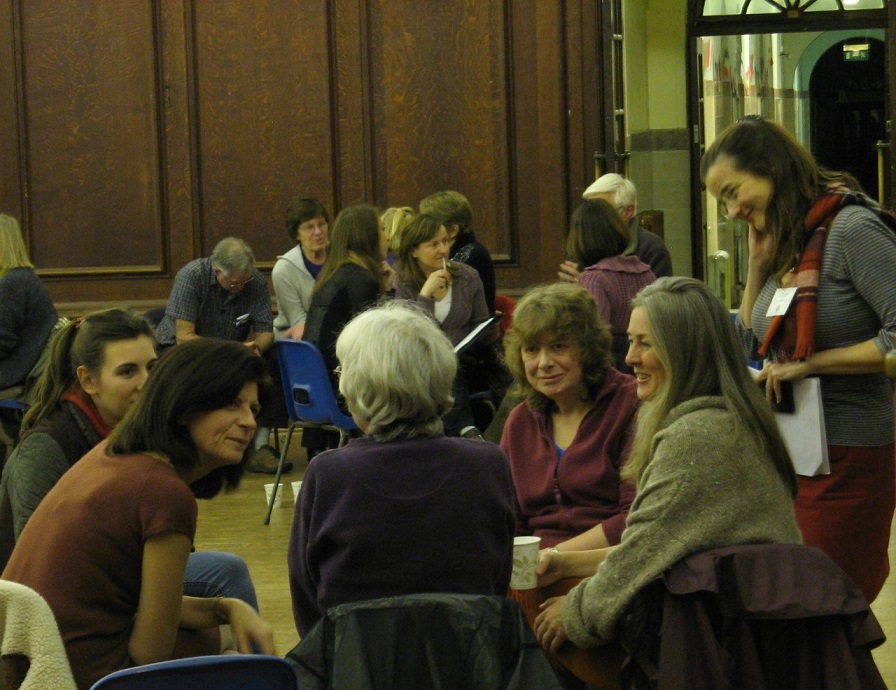
Doors opened at 7pm, and the steady stream started from the off. Food was bought, and it seemed that every other person who arrived hadn’t pre-booked. We’d not put enough chairs out. From pre-bookings of 77, we ended up with a very full hall of 130 enthusiastic folk, waiting to be inspired. They were very much not disappointed.
Polly TalkAfter an introduction from our very own Emma, Polly took to the floor. Without notes or slides, she let her trained barrister skills, natural charisma and deep understanding of her subject flood forward and wash over us. We surfed the rolling waves of her talk as she expertly balanced between emotion and logic.

We heard how, while she was overseeing an injury claim in the courts, she realised that outside there was a neglected and huge victim, laying seemingly passively outside her window. She decided to become the lawyer for the Earth.

That lead her to endeavour to introduce Ecocide as an international crime against Peace, within the Rome statute alongside genocide and war-crimes. It lead her to find out that Ecocide, the intentional destruction of eco-systems, was originally written into those very same international laws when they were first considered in 1972. It lead her to the incredible realisation that they had been dropped suddenly, with unpublicised and secretive discussions at the UN. Three countries had successfully lobbied to have the laws removed in 1996.

Those countries? The United States of America. The Netherlands. And the United Kingdom. In 1996. Under Sir John Major as Prime Minister.

The law can and should be passed. There are 121 countries signed up to make it so. All that is needed for it to be tabled is for one of those countries to put it forward. To do so, they need a mandate from their people.

So it is now our job to create that mandate.

Stroud recently formed Stroud Wants Ecocide Law. Other something like that. Spells SWEL. So we may form B-WEL. Berkhamsted Wants Ecocide Law.

If in 1996 Ecocide had been made a crime, as it rightfully should, the rainforests of the world would now be expanding, the tar-sands in Canada would be a pipe-dream and climate change mitigation would be well under way. Without it? What do you think?

It can happen by 2020. It could happen sooner.

John Bell

Ordinary Bloke

Me, my family and out from there

Where am I?  This post is an update on all the various projects I am trying to keep afloat.  I have a little too much on.

Some deep thinking over the Christmas period, while North Wales was battered with 100 mph gusts, has lead me to conclude that I need to prioritise from the inside out.

What does that mean?  It means I first need to make sure I am taking care of my inner self, then my health, then family, friends, home.  After that I can start to look at my local area, town and then further afield to the rest of the UK and abroad.  Unless I take that approach, anything I do that reaches too far from myself will be built on shaky and uncertain foundations.

So, what I should be doing is training myself to be in the moment, with a grounded understanding of where I am pointing.  Then making sure I get enough sleep, a decent diet and exercise.  I’ll give myself a 5 out of 10 for that – too many late nights, not enough exercise and ending up ahead of myself all too often.

Family life is fun and fulfilling at the moment.  Rowan and I are in a very good place, and the children are a laugh a minute, while still growing fast in all regards.  Little James is enjoying standing, not yet walking.  I’d like to spend more time with them.  8 out of 10 for family.

Rowan and I are trying to sort the house out, with a major, if slow, de-cluttering exercise underway.  An aversion to waste has lead us to hoard leads, toys, magazines, off-cuts, you name it.  So we are trying to be ruthless in clearing it all out.

In Berkhamsted, there is the B-Hive project as well as the Transition Town.  The B-Hive is the community initiative to give a voice to the people of the town to have their say about how it develops, and is now becoming the vehicle to help deliver those needs.  After a town consultation and a 96-page report, we’re now lobbying local government and building up the capacity of the team.

On 22 January, Transition Town Berkhamsted (TTB) are hosting the second Ashlyns Lecture, with the incredible Polly Higgins coming to the local secondary school.  Polly is one of the top 10 most visionary people in the world according to the Ecologist, and I am looking forward to her visit.  We’ve been out at the market raising awareness and selling tickets.  Book your place now!

Next steps for TTB are to identify a big project or two to rally the troops around.  My preference would be either community energy or Transition Streets.  I’ll give myself a 7 out of 10 for the local town.

Beyond that, I’m organising two conferences.  The first is for the dozen or so Transition Towns in the area, so we can share our stories and ideas.  The second is the UK Power Shift, part of the Global Power Shift, which links strategically in with the UK climate movement.  The aim of the latter is to link the climate change activity in the UK with each other and to the rest of the world, so we can all feel part of a major movement towards a more responsible future.  I’ll give myself a 7 from 10 for UK and abroad, but this could slip if we don’t get more support.

Oh, and there is the ongoing idea of creating an online platform to allow people to challenge the misleading climate change articles that appear all-too-often in the press.

In general, I’m wanting to build up the number of people involved in the projects in the local town, UK and abroad.  I don’t want to see any of the initiatives collapse, and so I’m trying to make sure there are enough people behind each before I can start to take a back seat and concentrate on one or two priorities.

John Bell,

Ordinary bloke

A time for giving

I’d like to ask a favour of you. I need two minutes of your time. I feel I have a decent idea of the sort of people who read this blog. But I’m not really sure what you think.

So, I’ve created a simply survey, with a handful of questions, for you to tell me. It works from a mobile or a computer, and takes only a couple of minutes to complete. Will you complete it for me please?

I’m not going to draw wild conclusions from the results about the state of the world. The sample won’t be representative of the population. I hope it will give me an idea of where you are with your thinking about the subjects of my blog.

Thank you very much indeed in advance. I look forward to seeing the results flooding in.

John Bell

Ordinary Bloke

How bad for us is our time of plenty?

We’ve got too much.  Our children are being brought up in a world of plenty.  It’s really difficult to stop the house getting piled up with mounds of plastic toys and games.  They’re getting spoilt; we’re getting spoilt.  I’m just as guilty of this as anyone else.
Spoiled child
All of this convenience is false.  It is by using the energy trapped in fossil fuels, built up over millions of years, and on the backs of the poorest, most destitute people in the world that our luxurious, care-free lives are built.  We’re merely using up our natural reserves, not really generating much that is new.

It is bad for us now; it is sickening for the poor and terrible for the future of the planet.  We have to stop.

And as we get more unused to the real effort of staying alive, we will find it more and more difficult to be able to cope if we stop using this natural capital and the poor of the world stop doing our dirty work.

To really understand what we are doing to ourselves and our children, I looked up the medical definition of what it is to be spoilt.  Spoiled Child Syndrome means indulging in excessive, self-centred and immature behaviour.

This can be a problem into adulthood.  People might have trouble waiting for that thing that they want now, such as a snack, new gadget or clothes.  They might have trouble coping with criticism, controlling their temper, maintaining professionalism and personal relationships.

But hang on, doesn’t that characterise western society?  Divorce rates are increasing, although they have dropped off since 2000 due to people marrying later and co-habiting more before marriage and the number of people getting married in the first place has been dropping off.  Obesity and fatness is rising across the population.

I find it difficult to stop myself gorging on all of the biscuits in the tin.  It is always tempting to just sit in front of the telly and eat.  People complain at the price of food, but it’s never been lower.  We do everything we can to avoid expending any effort, such as by driving round the corner for a pizza or ordering one in.  We can get any thrill at the touch of a button.  It takes more and more to get us excited, which leads us to create and watch sickening violence in films such as Saw just to keep an inane smile on our faces.

To get out of this cycle has to start with number one.  I’ve got to train myself to recognise the indulgent cravings and lead by example, particularly for the sake of my children who copy everything I do.  I can spot the greed in the small things, when I quicken slightly and fumble when making a cup of tea, with the biscuit tin in the back of my mind.  It’s at these points that I need to intervene in my curtailed freedom of will, and deliberately slow myself down and ration myself.  I can slowly start to gain control of my life.

I’ll need to put more effort into really growing my own food and getting connected with where it comes from.  I’ll continue to get around by using my body walking and cycling, rather than driving, where I can.

As I persevere I hope it will rub off on my children, and allow them to be free and balanced.  If I am successful at it, maybe others watching on will be able to break free as well.

Does this strike a chord?  Or does it not make sense to you?  What are you going to do about it?

John Bell,

Ordinary bloke

“Not standing for it anymore” part 3 – nearly there

And so the saga continues, with more from the Telegraph, and more from me. It appears that the toing and froing is now at an end. We now await the initial ruling of the Press Complaints Commission.

The final throws of the bout, with my words in italics, those of the Telegraph in blue and the PCC in bold:

Further to Mr Bell’s comments on ours, and in reply to the Commission’s inquiry about an initial typographical error in the article:

1. Mr Bell does not appear to be complaining about our initial typographical error. The figure of 0.2 deg C highlighted by Mr Bell was never published by the Telegraph. That figure did, however, feature in a piece in The Mail on Sunday on 15 September 2013. As we said in our original comments, the original typographical error in the Telegraph report was the misplacing of the decimal point in the reference to the previous warming rate per decade of 0.13 deg C. This was swiftly rectified.

I agree that I am not complaining about the initial typographical error.

2. The article did not contain anything that was factually incorrect or misleading.
What is clear is that the 0.13 deg C warming rate per decade specified in the IPCC’s 2007 report (see http://www.ipcc.ch/pdf/assessment-report/ar4/wg1/ar4-wg1-spm.pdf, page 5) has been revised to 0.12 deg C, a revision of eight per cent. It is also a fact that the temperature increase at the Earth’s surface has been found to have slowed, something that the IPCC accepts they did not predict. We do not see the need to associate the word “wrong” with an implication that the forecasts were “more out than they were in reality”, as Mr Bell suggests. “Wrong” simply means “incorrect”. The IPCC do include a margin of error on temperatures in the latest report; the fact remains, however, that a headline figure has been changed. The public is entitled to be alerted to this and other changes between the two reports.

The reference above provides the error margin in the latest report – 0.08 to 0.14 deg C per decade. Which of course includes 0.13 deg C.

I am not sure what reference the Telegraph have for the statement of 0.13 deg C in previous reports. This may be it (http://www.ipcc.ch/publications_and_data/ar4/wg1/en/faq-3-1.html – see the graph), which states that over a 50 year period (roughly equivalent to the 0.12 deg C figure, (from 1951) that the change is 0.128 ± 0.026 deg C (i.e. 0.102 to 0.154 deg C). You will note that this includes 0.12 deg C.
Given these ranges, the forecasts are not incorrect or wrong, simply different. To state that they were wrong or that the IPCC admit they were wrong is inaccurate and misleading.

The statement above that the IPCC admit that they did not forecast the short-term slowing of surface temperature increase is a different point. The IPCC projections are for several decades, and are the average of the outputs of several models. The observed surface temperatures are effectively of one model run, i.e. reality. Comparing an average figure with a range of uncertainty against a single observation is akin to comparing apples and pears.

3. That the IPCC did not explicitly “admit” the change between 0.13C and 0.12C (the 0.13C to 0.12C change appears to be somewhat buried in a discussion about trends based on short records – see page 3 at http://www.climatechange2013.org/images/uploads/WGIAR5-SPM_Approved27Sep2013.pdf ) does not make the Telegraph’s report inaccurate or misleading. The difference in warming rates is still an admission, however downplayed it may be in the written report, that something has changed since the statement in the previous report. Further, more explicit, admissions on other aspects of climate change were made in the 2013 report, as noted in our original comments: for example, the IPCC accepted that the effect of increased carbon on world temperatures may not have taken enough notice of natural variability; that Antarctic sea ice has grown rather than declined; that some regions of the world were as warm in medieval times as now. These are all changes that readers are entitled to hear about. The IPCC were contacted by the Telegraph for comment, but they did not respond to this request.

Page 3 is not buried, where the first two pages are the list of authors and the introduction. Use of the term here demonstrates a biased viewpoint on the report and on the IPCC on behalf of the Telegraph. The remainder of the point above is a repeat of earlier correspondence.

Mr Bell’s comments on our supplementary reply do not appear to raise any new substantive argument. But contrary to the points he does make:

1. We gave a clear reference to the 0.13 deg C warming rate in the 2007 report in our point 2 of the supplementary reply and there is no need for Mr Bell to be “not sure” about the reference and suggest one of his own.

2. We did not say “Page 3” of the 2013 report was “buried”. What we said was that the 0.13C to 0.12C change appeared to be somewhat buried in a discussion about trends based on short records, which appeared on page 3.

Should the Commission be asked for an initial view now?

At this stage, you may want the Commission to come to a view on your complaint under the terms of the Editors’ Code of Practice; please do let me know if this is the case.

The Commission would be deciding whether it was significantly misleading for the article to have claimed that the downward revision of projected surface temperature increase in the IPCC’s 2013 report meant that its earlier forecasts had been ‘wrong’.

Do let me know how you would like to proceed.

I agree with the Telegraph that I would like the Commission to come to a view.  I would clarify the question as follows:
 
The Commission would be deciding whether it was significantly misleading for the article to have claimed that the downward revision (bearing in mind stated error margins) of projected surface temperature increase in the IPCC’s 2013 report meant that its earlier forecasts had been ‘wrong’.
 
Thank you for your help in this matter.

I will now send your complaint to the Commission for a formal ruling under the Editors’ Code of Practice.

The Commission can take a maximum of 50 days (35 working days) to reach a decision, although the time frame is usually much shorter.

So, here we go.  It does take a lot of elapsed time, does it not?

John Bell

Ordinary Bloke

Glimpse of the future on a Welsh mountainside

Could this be my future?  Do I want it to be?  We passed via a Welsh mountain settlement on the way up to see my folks for Halloween (some ghostly pictures below – brace yourself).

A few weeks ago I bumped into a good friend Rachel in the local Waitrose.  Yes, I was buying a few things, I hate to admit it.  Rachel introduced me to a couple she has known for years – Mandy and Adrian.  We only spoke for a minute or two, trying to resist the gently urgent tide of people going about their shopping chores.  In that short time we realised we shared life ambitions.

And so it was that I was driving my family up a winding lane in the mountains of North Wales, with my mother behind, following the complicated instructions Adrian had just given me over the phone as to how to get to Ty Newydd from Bodelwyddan.  We parked up hopefully at the bottom of a muddy, rock strewn drive in the hope I’d managed to break a habit and follow some directions.
Ty NewyddAfter a few minutes of comfort breaks for the little ones and debates about footwear, we trudged up the hill, and were relieved to be met by our hosts.  We were invited into their welcoming, rustic house for a welcome mug of tea.  After distracting little baby James with a box of dominoes, which he decided to deliver to me one by one, we got on to their life story.
Mum and MandiOver 20 years ago the couple moved into a shell of an old farm house on the Welsh mountainside.  They set to work covering up the open windows and fitting a ramshackle Rayburn stove to cook and keep warm.  They had little money, less paperwork and no experience.  But with determination and the help of the wooded mountainside, they slowly turned their inhospitable abode into the idyllic place to live that it is now, bringing up their family into adulthood at the same time.

They built their wood timber home and barn themselves.  It’s completely off-grid, with power generated in the main from solar panels – they have a room full of batteries.  They do have a back-up petrol generator in case, with the tensions that brings when the grown kids want to use that little extra electricity.  Most of their food is grown on site.

Adrian has built up a business managing the wood, with his own saw mill.  He has designed a house that can be built truly affordably – no more than £40,000 – in a way that doesn’t compromise the future.  He works hard to keep costs as low as he possibly can.  Mandy and her daughter weave the most exquisite baskets from willow.  Their two sons carve beautiful objects from the trees, in their barn workshop.

They are now looking to expand the settlement.  The idea is that they build a number of these low cost houses across the valley, again off-grid and with food grown on-site.  They are in the process of looking for planning permission from the council.
Ty ElwyAt times, this life can be difficult.  When the sun is covered and there is little wind, the battery power can start to wane they can struggle to get enough electricity.  They can run into problems with other local people who have a different value system.  They also had the ordinary, day-to-day issues to deal with such as squabbling kids.

They see the future as being one where people migrate back to the country from the cities and are looking to help get it started.

I agree.  When we can no longer rely on fossil fuels to run our farm machinery, fertilise our crops and transport the results to our door, we will need to find another way to feed ourselves.  Small scale, high yielding, low machinery food growing methods such as permaculture become the way forward.  That will mean a lot more people growing food.

Either way, I am interested in the lifestyle.  Even if a mass migration to the country isn’t part of the future, my family doing so would mean that we would further reduce our impact and would be sheltered from the coming storm.  I’m not necessarily sure my wife would agree, but that’s a different story.

We finished the visit with a tour of the managed woodland and a look at the saw mill and the designs for the houses, before heading to my childhood home on Anglesey with my mother.  Thank you very much to the wonderful Mandy and Adrian for showing so much hospitality to a vague acquaintance.

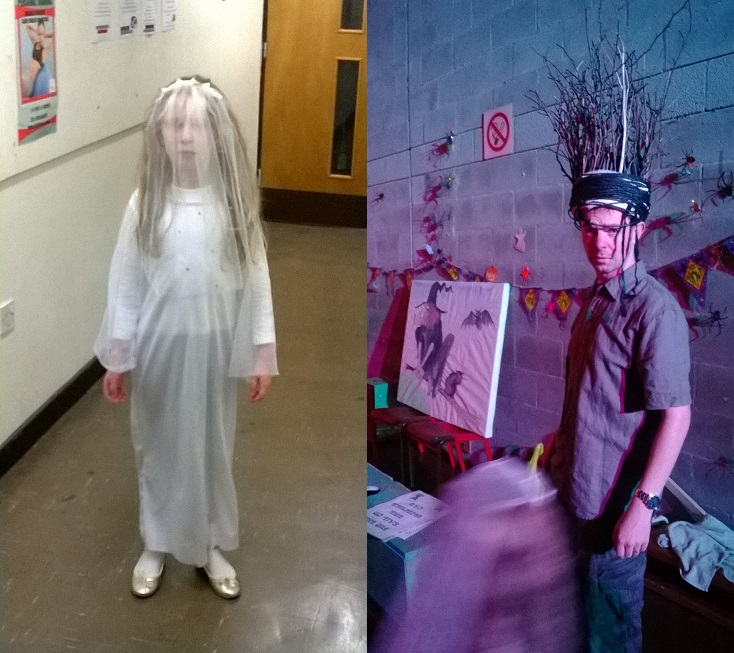
A few days later we were in a Halloween party in the Canolfan, organised by said mother.  Maddie looked very realistically ghost-like.  I wonder if you can guess what I am dressed up as? (and, yes, that is Maddie getting more ethereal by the minute in the foreground).
Maddie Ghost
John Bell,

Ordinary bloke

“Not standing for it” update 2

Since I raised an official press complaint against a Telegraph article, the UK Press Complaints Commission have effectively acted as an intermediary between me and the paper.

I posted the Telegraph’s thoughts up on a couple of websites to see if anyone else could help me draft the response, but didn’t get a reply, other than a few Likes.  For the purposes of setting up a mechanism for the public to challenge misleading articles, I’m learning about the amount of individual effort required to manage a complaint and that a pool of volunteers would be necessary.

Below is my first interchange with the Telegraph that was overseen by the PCC.  My official complaint is in bold, my replies are in italics, the Telegraph’s in blue, indented.  I’d be very interested to hear your thoughts on their arguments or my own.

The overall complaint is that the article misleads by highlighting any differences between climate forecasts and observations and claiming as a result that the forecasts have been “wrong”.  Given these were forecasts decades in length, for the word “wrong” to be justified a large discrepancy between the forecast for a large part of the globe would need to be observed.  In fact the differences have been relatively small and not widespread.  The forecasts have in fact been very accurate.

The title is misleading, stating that “global warming” forecasts were wrong.  In the article, it admits that the forecasts were for 0.13 degrees Celsius warming per decade, where it has actually been 0.12 degrees Celsius.  I understand that originally the article stated that the forecast was for 0.2 degrees Celsius per decade, but has since been corrected.  The headline made more sense with the original figure but now misleads.

The second sentence repeats the claim in more stark terms “world is not heating at the rate they claimed it was in a key report”.  This is again misleading given the difference between forecasts and actual warming.  The context of this line below the headline links the statement that forecasts were wrong with the rate of heating.

The second paragraph states that the IPCC report “is understood to concede that the computer predictions for global warming and the effects of carbon emissions have been proved to be inaccurate”.  The words “computer”, “prediction” and “predictions” do not appear in the report at all.  There is no direct statement in the report to say that previous forecasts have been inaccurate.

The complainant Mr Bell suggests that this article – published ahead of the publication of the latest IPCC report on climate change – was “misleading” because it highlighted differences between climate forecasts and observations and claimed as a result that the forecasts had been “wrong”. Mr Bell suggests, without explaining why, that for the word “wrong” to be justified a discrepancy that was “large” would have to be identified. He does not define what “large” means.

This is a fundamental point of the complaint.  In common language the word “wrong” is not used when there is a small difference between a forecast and reality.  It is misleading to use the word in this context.

To illustrate the point, say there was a weather forecast that said that the average temperature in the UK tomorrow is expected to be 13⁰ C and that it will be cloudy in the north and clear in the south.  Say the reality was that the average UK temperature turned out to be 12⁰ C, it was cloudy in the north and clear in the south, and there was some rain over Edinburgh.  In that situation it would be misleading to describe the forecast as being wrong.  “Slightly different” would be more appropriate, “largely accurate” would be better.

We are talking about whether the readers of the Telegraph would be misled by the article as it stands.  The common language interpretation of the headline would be that there is a fundamental difference across the board between the forecasts and reality, which is not the case.  There are a few minor differences, overall the forecasts are close and this does not undermine the forecasts viability for use in informing policy and individual action.

I would like to add at this point that the report does not explicitly admit that forecasts were wrong.  This is an interpretation of the journalist, and has been expressed in a misleading manor that could lead the readers to draw inaccurate conclusions.

He also complains that the article was “misleading” when it said that the “world is not heating at the rate they claimed it was in a key report [ie the 2007 IPCC report]”, given the difference between forecasts and actual warming. He further complains that because the latest IPCC report did not contain the words “computer”, “prediction” or “predictions” this disentitled the article from suggesting that the IPCC were going to concede that some predictions about global warming and the effects of carbon emissions had been inaccurate.

The Telegraph contests these claims.

For the record, when the article was first posted online it contained a typographical error – rather than saying 0.2 degrees C as the warming rate per decade, as Mr Bell suggests, it set out the difference as between 0.12 and 01.3 degrees – the decimal point had been put in the wrong place. This was corrected within minutes of the article going live, which is probably why Mr Bell did not actually see it. This was explained to him when he complained to the Telegraph’s online desk. No content of the article was based upon this error.

The actual difference between the two IPCC reports – between 0.12 degrees C and 0.13 is clearly stated in the article and is factually correct. This figure therefore justifies the statement in the introduction – that the world is not warming at the rate the IPCC claimed it was. They have revised the estimate by eight per cent; they have changed their predictions.

They have revised the estimate by 8%, or in other words the new figure is 92% the same as previously.  The statement “Top climate scientists have admitted that their global warming forecasts are wrong and the world is not heating at the rate they claimed it was in a key report” associates the word “wrong” with the rate of warming predicted.  To anyone other than a lawyer this would appear to imply that the forecasts are more out than they were in reality.

This alone, as was explained to Mr Bell when he got in touch with the Telegraph directly, was not the entire basis for the headline. There have been numerous changes within the reports – including a revision from a claim that the world is at its warmest in 1,300 years to an acceptance that parts of the world were as warm in medieval times (these statements are not mutually exclusive – the report does not back down from the claim that the world is at its warmest for 1300 years); the fact that sea ice has shown an increase recently that the IPCC do not explain, and the fact that there has been an overestimation of the effect of greenhouse gasses. (this again relates to the difference between 0.12 and 0.13 – “wrong” is again misleading in this context)

The basis for the statement that the IPCC concede that computer predictions for global warming “have proved to be inaccurate” is based partly upon the fact that they have changed the data between this report and the last, released in 2007.

Using “have proved to be inaccurate” to describe a situation where a forecast from 6 years ago is simply different to one now is misleading, in common language terms.  Furthermore, the forecasts are within their error margins – they are demonstrably not inaccurate.  I am confident that if asked the IPCC would not agree that the forecasts have proved inaccurate.

Furthermore, the latest report states, when explaining a reduction in the warming trend since 1998: “There may also be a contribution from forcing inadequacies and, in some models, an overestimate of the response to increasing greenhouse gas and other anthropogenic forcing (dominated by the effects of aerosols)”

Another example, as stated expressly in the article, is that: “Most models simulate a small downward trend in Antarctic sea ice extent, albeit with large inter-model spread, in contrast to the small upward trend in observations.”

We do not accept Mr Bell’s complaint about computer predictions. Although the IPCC may not specifically use the terms “computer” or “predictions” in their report, this does not mean that the article is not factually correct. Newspapers are entitled to summarise the facts in language readily understandable by average, non-scientist readers.

For example, “continental-scale surface temperature reconstructions” were used to predict what the temperatures were during “the Medieval Climate Anomaly”, part of the basis for global warming forecasts and the results of which were revised between the two reports. The Telegraph does not believe it was misleading the reading public to say that these are predictions that have been constructed using computers, as were the models mentioned previously.

There is no direct statement from the IPCC admitting that they were wrong about their earlier forecasts; they did not respond to our reporter’s request for comment.

But the fact that they have changed data as compared with their report several years ago shows that they have conceded that some data was inaccurate, or it would be exactly the same in both reports. The article and the headline were an accurate summary of what has occurred.

Stating here that “some data was inaccurate” is not what was said in the article, which said that the report admitted that forecasts were wrong.  The report did not admit that at all – it is a misleading interpretation of the report.  If the article had said that the report admitted that some elements of the previous forecasts were wrong, or said that the Telegraph reporter thinks that they are wrong, then it would be more accurate, but in my opinion still misleading as the forecasts are within error margins.

Furthermore, Professor Myles Allen, the director of OxfordUniversity’s Climate Research Network, a leading climate scientist who worked on the report and had seen the draft, told our reporter that the IPCC had changed their predictions.

The Telegraph takes the view that Prof Allen’s comments provided balance to the article and the headline as well as backing them up, as he justified the changes by saying that science works by revising predictions based on newly emerging data.

As far as what a “large” discrepancy between temperatures is, it is clear that global warming is a vast subject on which there is much debate, which – as the Press Complaints Commission has ruled on many occasions – should not be stifled. Mr Bell is entitled to hold the view that the eight per cent discrepancy is not, in his opinion, “large”. Not everyone would take an identical view, and many would indeed conclude that eight per cent is a significant figure.

In any event, the word “wrong” is not based upon this discrepancy alone, and it should be read in the context of the article as a whole.

This is made clear in the introduction: “Top climate scientists have admitted that their global warming forecasts are wrong AND [our emphasis] the world is not heating at the rate they claimed it was in a key report.”

There are numerous changes between the reports – the forecasts of sea ice extent have changed as have the predictions on the effect of greenhouse gasses.

The complaint that the word “wrong” is used just to describe the discrepancy is Mr Bell’s own interpretation, whereas the headline should as be read in the context of the entire article, not just the second half of the first paragraph.

If the article showed where the forecasts have been right as well as the few instances where they have been different, then it would not be biased or misleading.  It picks out only those elements where there are differences between one set of forecasts and another set 6 years later.  No forecast on any subject would expect to be exactly the same in all elements to reality or to a forecast made several years ahead.  All forecasts on any subject would be described as “wrong” and “inaccurate” following the highly suspect logic portrayed in the article and in this response.  The article is misleading and biased and is in breach of clause 1 of the Editors’ Code. 

Arguing otherwise is an admission that the journalists and editors of the Telegraph will twist reality and use weasel words to create a message of their choosing rather than to communicate issues in an unbiased, objective manner to help their readers understand the world.

I am deeply concerned by the arguments put forward by the Telegraph.

Nothing in this article constitutes a significant inaccuracy or misleading statement contrary to clause 1 (Accuracy) of the Editors’ Code.

So, what do you think?

John Bell

Ordinary Bloke
How is “not standing for it anymore” going?

What happened to my idea of combating misleading press articles?  Here is an update, including about a press complaint I have started to see how things work.  This is the first of a series of posts I’ll put up about how that complaint goes.  I’d welcome your thoughts.

The initial idea was to gather a lot of people around a complaint to the Press Complaints Commission (PCC).  Earlier advice that the PCC are pretty ineffective in cases concerning climate change and that was backed up in a recent conversation with the fantastic people at Carbon Brief.  They pointed me at an article about how to get complaints to work.  It concludes that they are only really effective if someone raises a complaint because they have been directly misquoted.  Generally, if it is about the science, they’ll let anything go.

So I have tentatively concluded that a mass of people online petitioning editors about individual articles could work, as was suggested by Bob Ward.  We’d then decide on a case-by-case basis whether to raise an official complaint, depending on a vote, bearing in mind the chances of success.  There is arguably little point wasting effort in raising a lot of official complaints via the PCC if the majority are not going to be upheld.  Best case we’d waste our time, worst the papers could use that as evidence that they can continue to say what they want.

The Climate Reality Project are the most likely group to host this website.  While I wait for them to get over a hump of work they have on at the moment, I have raised a press complaint of my own to find out how the system works, as John Cook of Skeptical Science suggested to me.

Before raising a complaint, the norm is to correspond with the offending editor first.  The article I chose, more or less at random, was published in the Telegraph in the UK.  Here is the correspondence I had with them before raising the complaint, following completing a form on the Telegraph website to say I wasn’t happy with the article:

For example (and this is only an example):

[1] It opens “Top climate scientists have admitted that their global warming forecasts are wrong and world is not heating at the rate they claimed it was in a key report”.  Factual inaccuracy – the reports are not forecasts, they are projections.  They do not predict over the 5-10 year short-term, they project an overall trend.  They do show occasional pauses in temperature increases, but do not claim to forecast where they lie.  

[2] The same sentence is misleading in stating that the projections are “wrong”.  Observations are within tolerance.  It is a misleading use of words to state that they are “wrong” – it is like saying that the weatherman got the forecast wrong if he said it would be sunny with a temperature of 22 degrees and it turned out to be sunny with a temperature of 23 degrees.

[3] The final paragraph avoids a factual inaccuracy with weasel wording.  It states that the IPCC insist that the Stockholm meeting is not a crisis meeting.  The dates for the meeting have been scheduled for years.  The article gives the misleading impression that the meeting has been arranged recently.  It is like saying that so-and-so insists they are not a pedophile, rather they are heterosexual: which would leave the impression that they may indeed be a pedophile.

The entire article is biased in this way, using wording that paints a misleading picture at every turn, and giving the overall impression that the IPCC have been wrong and are in crisis, which could not be further from the truth.

I could go on.  You will be aware that it is reportable if an article is factually inaccurate or misleading or biased.  This article is all three.

I repeat that if an apology is not published with the same level of prominence as the original that I will report the article to the Press Complaints Commission.

Thank you for your reply.  I have spoken with Hayley Dixon and she has stated:

Firstly, I do not accept that there is a difference between projections – defined as “an estimate or forecast of a future situation or trend based on a study of present ones” -and forecasts – defined as “to predict or estimate (a future event or trend)”.

I do not understand the complaint that the IPCC do not predict over the 5 to 10 year period, these are decade on decade predictions since the 1950s – as is confirmed by the IPCC in their previous report.

Secondly the projections are different – there is an 9 per cent difference between the figure in the 2007 and the figure which is due to be included in this report, as amended by the scientists.

Thirdly I dispute that saying the final paragraph uses “weasel wording”. Again, this is a statement of fact. The IPCC has insisted that this is not a crisis meeting, as can be seen by a press release on their website.  At no point in the article does it state that this is an emergency meeting, or that the organisation is in crisis.  It does suggest that the IPCC have been incorrect in some areas, because this is the thrust of the comparison between earlier reports and leaked documents. The IPCC did not respond to a request for comment. 

However, I believe that the comments from Professor Myles Allen, a contributor to the report, provide a balance by pointing out that the data is not infallible, and that science works by changing predictions according to emerging data. This clearly does not suggest the IPCC is in crisis, it just shows that this is the way that science works.

Thank you for your response.  I will now report the article to the press complaints commission.

Before I take this forward with the PCC, I would be grateful if you would consider changing the headline of the article.  I think this is the most serious issue with the article.  

It states “Top climate scientists admit global warming forecasts were wrong”, where the now revised content of the article states that the difference is that predictions were for a change of 0.13 degrees Celsius per decade, where it has actually been 0.12 degrees Celsius.  The article originally inaccurately stated that the forecast was 0.2 degrees Celsius per decade, which would have been further from the observations, but with the correct figure the headline now seems inappropriate.  

Would you say that the weatherman had got the forecast wrong if he predicted cloudy and temperatures of 13 degrees, and it turned out to be cloudy with temperatures of 12 degrees?

A more accurate headline would be “Top climate scientists admit global warming forecasts were 92% correct”.

The headline is not based upon that statistic alone, for example it is based on the concession in the second paragraph that the effects of carbon have been misinterpreted, that forecast computers may not have taken enough notice of the natural variability in the climate, the changes to the historical data on temperatures between 950 and 1250 AD, and so forth. 

Would you be willing to publish a letter from me to counter that biased and misleading viewpoint?

If you wish a letter to be considered for publication, please e-mail it to dtletters@telegraph.co.uk (The Daily Telegraph).  Please include your name, address, and work and home telephone numbers.

Regrettably, due to the amount of letters received on a daily basis, it is not possible to print each one.

And so I then raised the official complaint – watch this space…

John Bell,

Ordinary bloke

Honey wine, a Compost toilet & Shifting the Power

A week ago Saturday I met up with the wonderful young people of Global Power Shift UK.  We managed to combine Eritrean honey wine, a night out in a trendy part of Brixton and a compost toilet with strategizing how to shift the power from money to people.

I’d got involved with the Global Power Shift (GPS) by first unsuccessfully applying to go to Istanbul earlier in the year.  I then met Nicolò Wojewoda of 350.org at a rally against the Keystone XL pipeline in London and went from there.

All national and regional GPS teams, covering everywhere on the planet where there are people, were tasked with creating their own Power Shift event.  The UK team has run a few events that could be described as a Power Shift and badged a few others with the same branding, but up until now hasn’t really found the unifying theme and idea that could be the start of something special.

Meeting in the British Museum with Nico, Ben Kurzman and Susan Poupard a few weeks ago, with my daughter Maddie reading a book beside us, we decided to hold a weekend workshop for the GPS UK team so we could nail down our ideas.

And so it was that a week ago Saturday I was waiting in fantastic Eritrean restaurant Adulis, sampling the honey wine and doing impressions of my son James’ Gollum-like crawl.  Femi was the unfortunate beneficiary, cousin of hip-hop artist KMT, who was to be our host.
Chess Set at May Project
We had a very interesting meal scooping up various different dishes with the think pancake-like bread injera and downloading the mind of Tara, who was unable to attend the workshop proper the following day.  The über-trendy Café Cairo was next – I was well out of place wearing my combats and carrying a rucksack.

I spent most of the night with my head on the floorboards in the music studio at the May Project Gardens in Morden, at right angles to the sleeping mat I’d brought.

The following morning started with my needing to negotiate the lack of toilet paper in the house.  I tell you, I was relieved, in both senses of the word, when I found the compost toilet marked on the helpful, painted map of the gardens.  The May Project Gardens is an inspirational permaculture set-up at the back of a council house in south London, complete with frog pond, herb spiral and polytunnel.  It was founded by a guy called Randy, whom I’ve not met, and KMT.  Permaculture is a way to live and to grow that apes nature, where waste is an alien concept.  It is highly efficient landwise – you get 2-4 times the produce by land area than farming – and requires less labour, chemicals and machinery.  The future as far as I can see.

The confidence inspiring Bernadette Fischler facilitated the workshop, which started outside with each of us drawing up a coat of arms representing our take on the GPS UK.  It was the day before the huge storm that cut through Southern England, so after a short while and a delicious falafel lunch we graduated indoors
GPS UK team at May Project Gardens
The upshot of our meeting of minds was a confirmation of our consensus view that we are here to help shift the power from money to people.  We intend to be the glue that allows diverse grassroots initiatives to share with one another and with the rest of the world.  To get that started, we are thinking that a Power Shift event where the those people and groups outside the traditional institutions can come together to meet each other, share stories and learn how to engage with the mass media.

Shift the Power UK is born.

John Bell,

Ordinary bloke

Independence schmindependence

We’ll need all the friends we can get if we’re going to get through the next few decades intact.  A few lone voices in Transition Town Berkhamsted (TTB) kept banging on about community.  I paid lip service to it, more as a means to an end, but now realise that it is fundamental.  Thank you in particular to Bridget, Trevor and Marc for the important lesson.

Early last year Ashridge Business School generously gave us the opportunity to host an event on any subject we wished.  After long debates we decided not to talk about climate change at all, but instead to call the day “Building Community” and the Future of Berkhamsted.  In organising the event we kept coming back to a circular discussion about how we would wheedle climate change back into the agenda, but the facilitator Chris Nicholls managed to persuade us that we should just let it go.

30 odd different community groups were invited and all accepted, from schools to business, council to sports, lobbying to charity.  All were very grateful for the opportunity to form a wider network and to look over the immediate false peak of our day to day lives.  There followed another Building Community day a few months later, where the theme of community space came through strongly.

TTB strategy is to go where the opportunities exist, following people’s energy as much as anything else.  To me, the most promising route was to concentrate on these Building Community days, develop our position as the glue for other groups in town and catalysts of positive change.  From there we would look at introducing a town plan or Neighbourhood Plan that considered the longer term, including local energy, food, transport and the like.

The third Building Community day built on the community space idea.  We decided to hold a design charrette for the area in the centre of the town that we understood was potentially up for development.

The B-Hive was born.

B-Hive logo
This proved to be a popular hit – the people of Berkhamsted really do care about their town being overdeveloped and losing its character.  A few people put in a lot of effort over a few short weeks to create a popular online presence and to be visible gathering signatories at the weekend markets and town fetes.  In a short time a mailing list twice the size of the TTB equivalent was populated.

Then the charrette came around, with a few hundred people coming through the doors to meet with a team of volunteering architects and urban designers to tour the sites, listen to talks, participate in hands-on workshops to sketch their own plans for the centre of the town, as well as listen to and watch local musical and other artists at play.

That was only the start.  The large pool of sign-ups provided another strange and very welcome quality.  They proved to be willing to help.  In short order, a team of about 30 people, including a sizeable team of architects, urban designers, surveyors, project managers and accountants set to work on a report of the findings.  It was hard work for all concerned, but worth it.

On 21 Oct a group of four of us met up with Dacorum Borough Council and with the Police Commissioner, key landowners on the potential development sites.  Both are now on board.  The Police originally delayed the sale of the former police station until we concluded our consultation, but now are running ahead with the sale.  The hopefully key and important difference is that the B-Hive report will be included in the sales pack.  This is the outcome for which we had hoped.

A bonus is that the people of Berkhamsted appear to want a town square and green space above anything else, i.e. more walking, talking and enjoying each other’s company and less driving.

Above all else, though, I have come to realise that the mere fact of getting people together as a community is the really important outcome of all of this.  It doesn’t so much matter what we manage to achieve regarding the developments in the centre of the town.  They are all a means to an end.  What really matters is that the relationships and interdependence between the people in the town is strengthened and made richer.

I originally thought that this building community work was a sideshow.  As far as I was concerned, we were just doing it to raise our profile.  How wrong could I be?

Our lives and the culture of our society are geared to make us more individual and more independent.  This will just make us all the more vulnerable when those faceless services of energy, food, money and water start to crumble.  We will be left with no support.

To really be able to cope, we need each other.

John Bell,

Ordinary bloke