A bit about me

I thought I’d let you know a little about myself.  In particular I’d like to mention what I have done (or not) to lessen my impact, and how I have benefited (or not) from my actions.  If any of this comes across as self-righteous then I’m sorry about that, I’ll try to avoid it.

shoot me studios-8660 10x8

As I mentioned in my first post, I am a father and husband, living in the commuter town of Berkhamsted.  I live in a smallish three bed semi with my wife Rowan and three children Maddie (nearing 7), Emily (verging on 4) and baby James.  Yes, I do feel a little guilty about my part in growing the population in the greedy west, particularly with the arrival of number 3 – so much so that I invested in a scheme to avoid deforestation in the Amazon that should offset all of the carbons that will be emitted due to James’ life.

Rowan thinks I am mad to attempt what I am attempting, but is supportive.  The kids haven’t really noticed.  As a family we are quite risk averse, and so that is why I have started the business alongside this work, so we can keep the wolves away from the door and allow me to continue to spend time on this going forward.

When it comes down to it, I’m doing this for the sake of my children.  We have a responsibility to leave the world in a better state for the inhabitants of the future than we ourselves found it in, and we are failing massively in that responsibility.

I first got aware of climate change when doing a geography project 20 years ago at school.  I was out there with a theodolite measuring the contours of the beaches around Anglesey where I grew up, and mapping how many times the local coast road would be flooded depending on the different projections of sea level rise at the time.  Difficult to remember exactly, but I think it was going to go up from being impassable a handful of times per year to a third of the year by the end of this century.

Like many people, it slowly dawned on me over the intervening years what sort of an impact I personally was responsible for, and I decided to change my ways.  I used to drive too fast and fly abroad regularly, something I wouldn’t dream of doing now.

At home we have had the house insulated and the 20 year old boiler renewed.  We’ve got solar panels fitted.  The loft insulation could be better: there is room for improvement.  I took part in an Eco-Team and reduced my waste, water, gas and electricity usage down by quite a bit.

Our water bills have a very useful graph on the back showing what typical usage looks like by size of household, together with what efficient use looks like.  With reduced flushing of the toilet, fitting of Hippo bags to reduce the size of each flush and general awareness, we use about a third less water than an efficient two person household.

With care we are now in the position where our revenue from the solar panels and our outgoings on gas and electricity balance off with one another.

I no longer commute to London, and we take holidays in the UK.  I’ve got a lot more time for the family, immediate and extended.  As a family we spend about £25000 a year in total.  That includes mortgage, bills, food, clothes, socialising, travel, holidays, the cats (two of them, Albert and Noodle), everything.  I have no useful barometer – does that sound low to you?

That has meant we have been able to save, and I have been able to make the step of leaving full-time employment.  If we’d carried on spending as we were, I’d still be working full time.

All in all, looking at the simplified calculator on the WWF website as to the impact you are having on the planet, I am still using up resources at a rate that would require 1.79 Earth’s to sustain it should everyone do the same, so more still to do.  Give up the car completely, maybe (great health benefits if I can)?  Become a vegetarian (I need some meat, surely)?

Please do let me know what you think.

John Bell,

Ordinary bloke

What have I been up to?

Berkhamsted_Castle_Jan_2007

Berkhamsted Castle – we could make more of this

It’s been a while since I have given a real update as to what I’m actually doing, which is remiss of me.  I’m going to change the balance of my posts so there are more about what I’m up to and fewer that sound more academic.

So, what have I been doing?  I’ve spent some of my time working on the strategy of Transition Town Berkhamsted (TTB), which is still a work in progress and needs the others involved to give their pennyworth before it is made official.  I’ve also been networking with organisations and individuals involved in the area, to discuss my ideas and help refine them.  I’m getting somewhere with that.  And of course I’ve been researching a little for the posts and responses to comments.

Berkhamsted is a commuter town, with a predominantly right-wing political outlook.  It is also quite large, with a population of 16000.  Unfortunately all of those things lead to it not having a great sense of community.  This makes it that much more difficult for the town to move forward in a meaningful way into the uncertain future.  We need to strike the balance between talking and engaging with local organisations, such as schools, and us taking the initiative, rolling our sleeves up and getting on with it.  There is some debate about that.  When the strategy is sorted I’ll put some more up about it on here.

The other difficultly in making a difference at a local level is the overall sense of apathy and denial on the issue of climate change, which is why I also want to work at a national level to help us overcome that temporary obstacle.  I say temporary because it is inevitable that nature will let us know in no uncertain terms that it doesn’t care whether we believe or not in climate change: it will just get on with dealing out the consequences.

My self-appointed job is to help us realise what we need to do before nature rubs it in our face, by which time it will be too late.  The idea is that we put together the toolkit required – credible information about the reality of climate change, plus information and support for people wanting to take action at home or in their towns or wider.  Then to launch it all with a big fanfare and bring the issue back square up front.  I certainly am not going to do that myself, and it is encouraging to find that a lot of organisations are already working closely together.

I’ll be posting more often from now on, so will explain more in a few days.

Please do let me know what you think.

John Bell,

Ordinary bloke
Who’s Getting the Fossil Fuel Subsidies?

The economic case for a large scale move to clean energy is undermined because, incredibly, government subsidies for fossil fuels are larger than the size of the global renewable energy industry.  This subsidy amounts to a greater incentive to emit carbon dioxide than the market price put on carbon emissions, by a factor of more than ten to one on current prices.

In a previous post I promised to look further into the calculation of the fossil fuel subsidy to understand who is benefiting and what is covered.  This is me fulfilling that promise.

In November 2010, the International Energy Agency (IEA), World Bank and OECD met a request of the G20 to produce a second report on the international energy subsidy.  In it, they define the fossil fuel subsidy as any action taken by a government to decrease the costs to the fossil fuel industry or to reduce the price of fossil fuels or fossil fuel based energy to consumers.  It is essentially the opposite of a tax.

They list the main reasons that the subsidies exist.  It could be to alleviate energy poverty.  It could be to boost domestic energy supply or to support industry development.  It could be to redistribute wealth in rich oil producing nations from the producers of the oil to the rest of the population.

The report argues how the downsides outweigh the positives.  The subsidies encourage wasteful consumption.  They increase energy price volatility (by disguising market signals).  Crime is increased as fuel intended for one purpose or market is used for something else or sold elsewhere.  They tend to disproportionally benefit the well-off, increasing the poverty gap.  Above all (for me) they undermine the competitiveness of renewables.  And of course the money used for the subsidy could be used for other purposes, such as healthcare, or increasing energy efficiency.

bribery

So, who is giving out these subsidies, and who is benefiting?  The IEA have available on their website a breakdown of the subsidies by country in an interactive map – have a play.  They are mainly in the oil producing countries of North Africa and Middle East, due to consumers within the country paying artificially lower for their energy than the country could in theory make by selling the energy on the international market.  For example in Kuwait domestic prices are 87.8% lower than they should be.  Iran has the largest subsidy of $82bn (17% of GDP), which needlessly lead the country to be a net importer of oil – fortunately they recognise this and are tackling it.

You would have thought that calculating the subsidy would be simple – you just add up the money given to consumers or producers, don’t you?  Perhaps unsurprisingly that is not the case, as the subsidies take many different forms, from direct money transfers, through creating a separate market or guaranteeing low prices for domestic consumption, to tax breaks or de-regulated access to government land for producers.

There are therefore several different methods for calculating the fi

gure.  The method used by the IEA is called price-gap analysis.  This method doesn’t include all diffe

rent types of subsidy (such as research and development into new technologies) by its definition, which is to calculate a reasonable market value available to a country, and then compare that with the price paid by consumers for energy within the country.  If they are paying less than the market rate, then their use is being subsidised.  If more, it is being taxed.

The encouraging news is that many countries that do subsidise fossil fuels do seem to be taking steps.  This gives us a chance that at some point everyone will be paying the market rate for fossil fuel use.  Capitalism will have that bit of an extra chance to prove that it is the right system to improve our lives while resources dwindle and without damaging our future.

Thoughts below please!

John Bell,

Ordinary bloke


Some Numbers – A 4⁰C World

In my last post I said I’d look into information available quantifying the effects of the level of climate change currently expected.  I have to admit that I’ve spent a very frustrating morning trying to find facts and figures about the effects and have not managed to find a great deal, particularly relating to the effects of the 4 to 6 ⁰C increases that are forecast on current trends (of change and our response to date and planned).

Anyone reading who has another or better source of up to date facts and figures about what we are letting ourselves in for, please do comment at the bottom of this post.

Generally what I’ve found is that when looking at the higher end of the forecast increases in temperatures, commentary in the scientific papers falls back on statements to the effect of “it will be really bad” and comparing with the coldest temperatures during the last ice age (5-6 ⁰C lower than current temperatures).

I think the lack of quantification available is genuine.  But I think some numbers would be better than none:

 “Uncertainty is an argument for a more, not less, demanding goal [on reducing greenhouse gas emissions], because of the size of the adverse climate-change impacts in the worst-case scenarios.” – Stern, 2006

And taking that a step further, lack of figures on the impacts is an argument for a more, not less, demanding goal, because the figures that we do have, particularly for lower increases, are bad enough.

Anyway, on to what I have managed to unearth.

My main source is a paper published in January 2011 by the Royal Society.  I’ll put links to the sources directly in the text below.  To start, a 4 ⁰ C increase is estimated to be reached during 2070s.

Looking at water, it looks as though dry regions are to get dryer and wet regions are to get wetter.  I found it difficult to interpret the graphs, but it appears to show a 30-70% decrease in the water available per capita, dependent on population growth and temperature change (the latter dominates in a 4 ⁰C world).  The regions under the greatest water stress at the moment are the US, Mediterranean Europe, India and China, plus parts of Africa – and these are the areas that are expected to feel the brunt of increases in water stress in the coming decades.  This is leading to increases in grain prices as water is used directly rather than for agriculture.

Looking at monetised costs, in Africa alone in 2030 for adapting to climate change are estimated at $60 billion per annum.  This still leaves residual effects that cannot be avoided.

Costs for global sea-level rises for a 4 ⁰C world are expected to reach $37-407bn per annum (I’ve adjusted to show present value), with the range depending on whether 4 ⁰C leads to 50 cm or 2 m of rises, which in turn depends on the unknown extent of the melting of the Greenland ice sheet in those conditions.

The Stern Report of 2006 costs of mitigating climate change are -2% to +5% of GDP (the lower part of the range relating to more prompt and efficient mitigation action), with an average of 1% of GDP.  Global consumption would decrease by 20% otherwise.  Then the net benefits of one year’s action to mitigate climate change would be of the order of $2.5 trillion.  So we should do so, you would think?

The UK parliament is currently discussing the Energy Bill.  It falls short in that it doesn’t commit to a target on reducing greenhouse gas emissions, and so I urge you to take action to promote amendments to the bill to introduce an end target and interim targets.  In developed nations, we need to largely decarbonise by 2030 for 37% chance of not exceeding 2 ⁰C (assuming developing nations peak their emissions by around 2025), according to the Royal Society.

The proposed changes to the bill not only give us a chance of mitigating climate change, they also make sound economic sense in the medium term.  It is estimated that there would be a £23bn saving in the UK if we went for de-carbonisation rather than for emerging fossil fuel deposits.  Gas prices (not renewables) were responsible for 62% of the increase in energy prices since 2004.

Again, if anyone reading has a different or better source of information about the quantification of the effects of a changing climate, then please do share by commenting below.

John Bell,

Ordinary bloke

I Don’t Believe in Climate Change

There, I said it.  I don’t believe in climate change.  It is not a religion.  People will often talk about it in religious terms (e.g. “preaching to the converted”), but it is not about a leap of faith or opinion as to what is going on.

We can understand the facts and then take a view on what we should do about it.

The facts are very clear that the planet is warming and that the cause of this is man-made.  Many, many studies by different people using different sources and different techniques have proved this.  It is natural that someone not convinced of this would find a way to deny it, at least in their own minds.  That doesn’t make the facts go away.

To pick out two sources of evidence, please take a look at recent work published in the Science journal showing how until the industrial revolution we were heading towards an ice-age, with temperatures slowing dropping for about 9000 years.  Or this video (with references) showing what proportion of the recent warming is man-made, and that it has continued unabated:

I could go on (and on and on), but I won’t.

Instead, what I want to know is what we are letting ourselves in for if we continue to emit greenhouse gases at the rate that we have (or more).

That is much trickier because we are talking about predicting the future.  The mainstream scientific reports on the issue (e.g. from the IPCC) give qualitative guides as to the probable effects and how quickly they will come about.  I want to know numbers.  I’m sure you do to.

How many species are at risk? How many people will be displaced or put into water or food distress?  What are the likely economic impacts?

Without some grasps of the numbers, it is difficult to know what courses of action are the most sensible (other than those that are obviously a good idea even in the absence of climate change, such as increasing efficiency to reduce energy costs).

I’ll address this in a future post or posts, after further research.  If you have some information on this, I’d love to hear from you.

Thoughts below as always.

John Bell,

Ordinary bloke

Is Carbon Capture & Storage the Silver Bullet?

Can Carbon Capture and Storage technology (or CCS for short) allow us to deal with climate change without damaging oil company share prices? Many hope that CCS will allow us to mitigate against climate risk without first going through a major global economic transition with the demise of the big oil and coal companies.

CCS, as I’m sure you know, is the process of extracting the carbon dioxide at the point that fossil fuels are turned into energy, and taking that carbon dioxide and storing it safely away under ground for long enough for it to decompose.

As described previously, if we burn the declared resources upon which the big fossil fuel companies share prices rest we will emit 5 times as much CO2 than we can afford to in order to avoid an average global temperature increase of 2° Celsius. And the oil companies are still looking for more – e.g. shale gas, searching the Arctic and so on.

Carbon capture and storage is seen by many as the way through that.

All of the individual elements of the technology exist and are in use. In fact, there are already 8 fully integrated schemes in operation with a commercially viable capability and another 64 in the pipeline (Global CCS Institute, Jan 2013 survey). We are already capturing 20 megatons of CO2 per annum.

Come on, this sounds great. Could it really do the trick? Let’s do some sums.

At the moment, we emit 33 gigatons of CO2 each year. In their scenarios, Shell forecast that will continue to increase to over 40 gigatons per annum by 2040, and will decrease thereafter.

The Global CCS Institute survey reports that they expect us to be able to capture more than 120 megatons of CO2 per annum by 2020. Oh dear, that was megatons wasn’t it? That means we will be capturing about 1 in every 300 tons of CO2 by 2020. A drop in the ever rising ocean.

We must be able to do better than that, surely? Shell scenarios help again, as one of the scenarios they evaluate (Mountains) describes a future where we go all out for CCS, starting in a realistic time frame. It is a little optimistic possibly on that front as the rate of deployment of that CCS outstrips even the most grandiose historic achievements (Kramer-Haigh, Nature 462, Dec 2009). In this scenario, we capture 30%  of CO2 by 2050, and all by the end of the century. We miss the 2° C target by miles.

If not CCS, maybe this?

If not CCS, maybe this?

So, we need to get a move on now rather than later. Unfortunately, the number of potential projects is going down rather than up (is 72 now and was 75 in October 2012). The UK competition (UK CCS Commercialisation Programme) has been held up at the Department for Energy and Climate Change as they are concerned about getting their numbers right following the UK Department for Transport being burned in the evaluation of the West Coast rail franchise competition. The European Commission’s NER300 competition awarded funding to zero CCS projects (out of an expected 12).

Clearly, this needs regulation and vastly quicker progress if this is to be the silver bullet. Let’s not pin our hopes in it just yet.

Thoughts below as always.

John Bell,

Ordinary bloke

The Future According to Shell

The long-awaited new scenarios from Shell were published yesterday. For 40 years Shell have foregone the typical Western convention of extrapolated forecasts to predict the future impacts of decisions. Instead they have regularly developed a small number of scenarios, where the most unpredictable elements of the future are varied to depict a few possible futures. The last set were in 2008, where two scenarios were created, Scramble and Blueprints – the distinctive difference between the two being that the latter allowed for unilateral, co-ordinated action to curb greenhouse gas emissions. These scenarios were unusual in that for the first time Shell announced a strong preference for one scenario over another*.

This time, Shell have really pushed the boat out and have ordained to attempt to predict the future to the end of the century. They are are great pains to point out that these forecasts are illustrations to help decision making now, not an augur into the unknowable future. The two scenarios they present are named Mountains and Oceans.

Mountains concerns a future where the concentration of power remains with the traditional few. In this world Shell foresee that economic growth will be constrained. They place relatively speedy introduction of Carbon Capture and Storage (CCS) in this scenario, due to a desire to maintain the status quo. This combination of lower growth and introduction of CCS means that the CO2 emissions for the Mountains scenario are relatively low, but still far exceed the trajectory needed for a 2 degree future.

It should be noted that the rate of deployment of CCS in this scenario outstrips the rate of deployment of any large-scale change to the energy industry in the past. This point is not evident from the report, but I am reliably informed that it is the case.

The other scenario is Oceans. Here, there is wider political reform, and the balance of power moves to less traditional places. The turbulence caused by this transition means that the strong policies needed to incentivise and bring in CCS and reduce greenhouse gas emissions are delayed.  In Oceans there is strong economic growth given this market freedom, and the overall emissions of this scenario are higher than in Mountains.

The report highlights that the individual components of each scenario are in some cases interchangeable. It would be possible, they say, for the faster introduction of CCS and other technologies and policies to limit greenhouse gas emissions to occur in Oceans as well as Mountains. They therefore also depict what they call a sensitivity with a more green Oceans outlook – which is still way off the 2 degree trajectory.

They also remark that the scenarios are interconnected; that the seeds of the political upheaval in Oceans lie in the stagnation of Mountains, and vice versa.

Shell - cropped

When discussing the sustainability of these projections, they make two very important points about greenhouse gas emissions. Firstly, they state that it is through leadership and policy making, rather than the markets, that the necessary changes to allow the curbing of emissions to happen can be brought through.

They also state that the projections do not include, as they put it, the climate turbulence that would result from their emissions trajectories. They state that this would severely damage the economy, dramatically lower energy demand and reduce emissions, albeit by a negative route.

They describe a possible future where in the 2020s the effects of climate change are so severe that rich and poor alike demand that the root cause of climate change be addressed, namely to dramatically reduce CO2 emissions within a generation.

Remember, this is Shell talking.

Thoughts below as always.

John Bell,

Ordinary bloke
* Blueprints, by the way, in case you were wondering
.

Your energy bill going up?

In the UK our energy prices are going up. That’s not the case world over. Some countries are seeing price reductions, and the overall picture is that we are on track for a 4° C rise. Policy makers appear to be happy with this, as it is lower than the 6° some portend, but this will be “horrible” according to Dr Fatih Birol, Chief Economist at the International Energy Agency, who spoke at Imperial College London on 6 Feb.

(The lecture is available on the web at the moment. Have a listen to it – it’s 1 hour 15 mins in length. If you don’t fancy that, then please read on and see my shorter paraphrased version below. Note that unless there is a link to another source all of the figures quoted below come from the lecture).

Alastair Buchanan, the head of the UK energy watchdog Ofgem, recently raised concerns about our increasing reliance on imports for our energy needs leading to increases in prices. But in the US they are on track to be largely energy self-sufficient by 2025, due to recent increases in domestic oil

and gas production (e.g. fracking), and decreases in domestic oil usage (due to for example regulation on car energy efficiency).

In Europe this has lead to a $200bn increase in annual costs of oil & gas (from $250bn to $450bn). Coal prices collapsed in Europe as the coal not used in the US (due to gas out-pricing coal in the states), leading to a large increase in coal usage in Europe (in 2012 the UK saw an increase of 20% in coal use).

It is jealousy of the situation in the states that leads George Osborn

e to want to tap into potential shale gas reserves in the UK. But there are genuine concerns about fracking (not seismic activity seriously, but more the escape of methane and the affect on the landscape – it’s not just windmills that suffer from that malaise – at least in the case of windmills the installation is easily reversible). And none of this helps us towards the 2° C target. Gas alone will not do the trick.

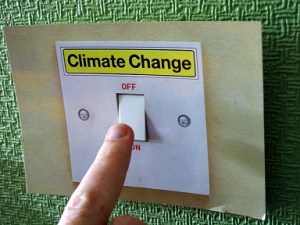
Climate Change Off Switch - reduced

Global energy usage is still on the increase, largely but not entirely due to the emerging economies. There is certainly a huge imbalance at the moment. For example, the entire energy usage in sub-Saharan Africa (population 850 million) is the same as for … New York.

Half of the expected global energy increases to 2035 are predicted to come from renewables – therefore the rest from fossil fuels. The increases in China are expected to be equal to the current usage in the US PLUS Japan.

This is at least in part due to the huge and increasing subsidies that fossil fuel production receives. Yes, it might seem ludicrous given what we know, but the global subsidy has passed $500bn (see from about minute 55 in the lecture). That is the same size as, you guessed it, the entire global renewable energy industry. Pause for effect.

In Europe our carbon pricing means that there is a $10 per ton disincentive on carbon dioxide emissions. The fossil fuels subsidies globally means that to counter that there is a $110 per ton CO2 incentive!

One of the upshots is that the energy efficiencies expected to be realised over the next decade or so (without new technologies) in industry, for power generation, transport and buildings, is only 1/3 of its potential. We could be a lot more efficient than we are, and a lot more efficient than we expect to be. There would be 2-4% increase in GDP if this untapped potential is released, e.g. by funds being found up-front to invest in energy efficiency.

We will use up 80% of the 2° C carbon budget using our existing global infrastructure alone. Add in expected building programmes and we will have used up the entire budget.  We will have closed the door on a 2° C future by 2017.

If we realise the energy efficiency potential of known technologies now, that can be deferred to 2022.

If you add in new technologies and changes in our usage, we still have a chance.

John Bell,

Ordinary bloke

Be the Change

Decision time. Off we go. Over the top. I’m going to concentrate on showing what can be done and how that is an improvement over the status quo. I’m going to focus my time in Berkhamsted with the Transition Town. In that way we can get on with making the necessary changes without the need to butt up against climate change dogma (pro or anti).

Berkhamsted - small

I will publicise what we do to show to the wider world what is possible. Optimistically, this will give others who want to do the same an example to draw upon and the motivation to take steps forward themselves. Pessimistically, it will highlight how our systems are geared up to stall progress. Either way, it will be a move forward.

At the same time, I recognise that motivating around benefits only might not provide the pace of change needed. When Hitler was threatening to invade Britain, Churchill didn’t motivate us to build lots of spitfires by extolling the economic benefits to the aerospace industry (although it did have that side effect).

So I will do my own research into quantifying the effects of climate change and what the size of the response needed will look like. I will engage with individuals and organisations to see what can be done to provide an unbiased, objective, peer reviewed source of information that is known as the place to go for information on climate change.

To publicise widely I will use social media as per this blog and will expand the audience of the blog via my new contacts with other organisations. I’ve got some ideas for publicity stunts to draw attention – how about a mass walk to London, or a very public open bet on the reality of climate change?

I will also need to start earning some money to allow me to keep going with my personal change of lifestyle. To that end, I have established a small company in an unrelated industry (passenger demand forecasting for the UK rail industry) to put bread on the table.

All in all, the aim is to get on with the move to a low-carbon future, and to show just how attractive that future is. I’m looking forward to it, are you?

I’d love to hear what you think, good or bad.  Last chance to influence!

John Bell,

Ordinary bloke

Just Imagine

What would happen if we got on the wagon and stopped burning fossil fuels?

The share prices of the energy and oil companies are based on the amount of coal, gas and oil that they have the rights to extract. Let’s assume for a minute that we go ahead and leave most of those reserves in the ground.

I’m not meaning that tomorrow we stop burning fuels, leading to utter disaster, I’m talking about a carefully managed move to not burning the fossil fuels. I’m doing this as a thought experiment. Let’s see where it goes.

There would be room for some fossil fuels to be used and I’d assume these would be used for the essentials – although I’m not sure how we would prioritise them. Health feels like it’s high up the list. As does food – but what alternatives are there for food?

If we were forced into reducing our reliance on carbon fuels, then we would necessarily need to come up with alternatives, to grow our food and conduct our day-to-day lives.

We’d probably go about by first looking at what we could reduce in terms of our usage – efficiencies or alternative ways of doing things. Then we’d look at how to find alternatives for those needs that remain.

To reduce our usage we could look at highly productive natural farming methods, such as managing cattle grazing habits to preserve the pasture (which actually captures carbon rather than emits it). We could make the most of the telecommunication revolution, which would allow us to travel less, both home and abroad. We could spend more time in our communities socialising with our neighbours rather than alone watching television. We could travel by foot and by bicycle, increasing our fitness.

There are ways we could reduce our usage further, which could start to feel like sacrifice, such as reduced flying.

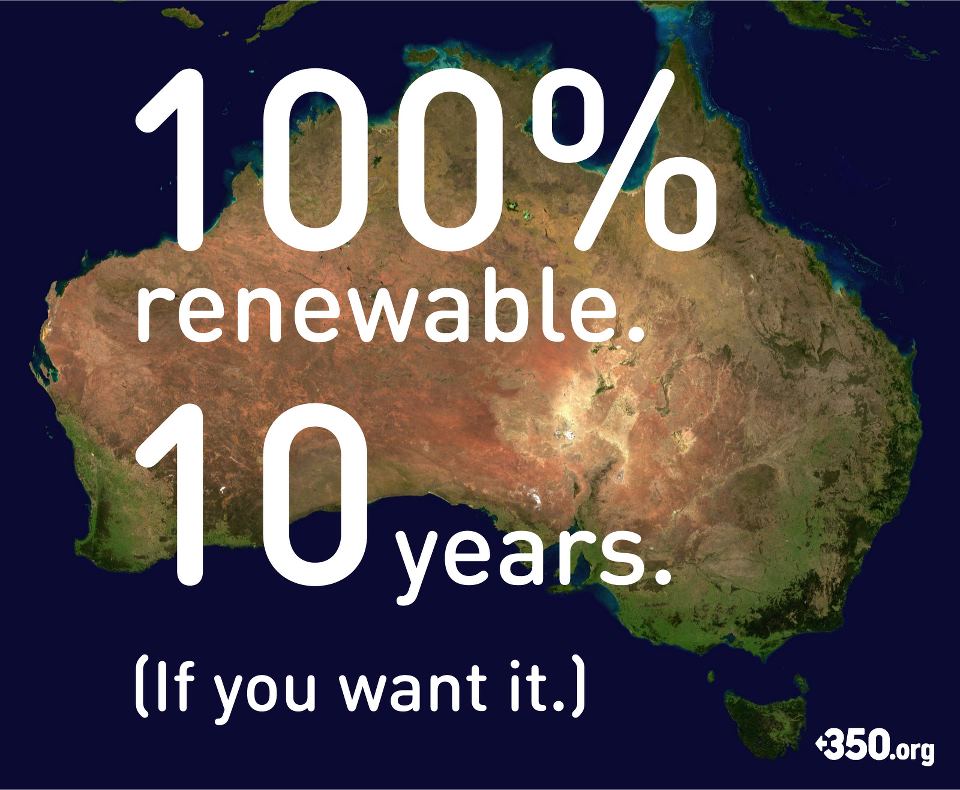
Then there are the things we could do to find alternatives. That means renewables or potentially nuclear for electricity, electric cars, low energy light bulbs (LEDs are good – they come on straight away and are bright).100 Percent Renewables in 10 years - Oz

What is important to know is how much of a change would be needed, at an individual level or wider than that, for us to avoid the worst effects of climate change. What would that look like to you and me. That is something I will explore and write about in the future.

One thing is certain…

Our lives would be completely different.

Worth the risk?

Thoughts below as always.

John Bell,

Ordinary bloke