Your energy bill going up?

In the UK our energy prices are going up. That’s not the case world over. Some countries are seeing price reductions, and the overall picture is that we are on track for a 4° C rise. Policy makers appear to be happy with this, as it is lower than the 6° some portend, but this will be “horrible” according to Dr Fatih Birol, Chief Economist at the International Energy Agency, who spoke at Imperial College London on 6 Feb.

(The lecture is available on the web at the moment. Have a listen to it – it’s 1 hour 15 mins in length. If you don’t fancy that, then please read on and see my shorter paraphrased version below. Note that unless there is a link to another source all of the figures quoted below come from the lecture).

Alastair Buchanan, the head of the UK energy watchdog Ofgem, recently raised concerns about our increasing reliance on imports for our energy needs leading to increases in prices. But in the US they are on track to be largely energy self-sufficient by 2025, due to recent increases in domestic oil

and gas production (e.g. fracking), and decreases in domestic oil usage (due to for example regulation on car energy efficiency).

In Europe this has lead to a $200bn increase in annual costs of oil & gas (from $250bn to $450bn). Coal prices collapsed in Europe as the coal not used in the US (due to gas out-pricing coal in the states), leading to a large increase in coal usage in Europe (in 2012 the UK saw an increase of 20% in coal use).

It is jealousy of the situation in the states that leads George Osborn

e to want to tap into potential shale gas reserves in the UK. But there are genuine concerns about fracking (not seismic activity seriously, but more the escape of methane and the affect on the landscape – it’s not just windmills that suffer from that malaise – at least in the case of windmills the installation is easily reversible). And none of this helps us towards the 2° C target. Gas alone will not do the trick.
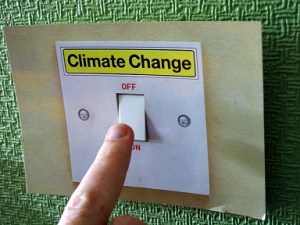
Climate Change Off Switch - reduced

Global energy usage is still on the increase, largely but not entirely due to the emerging economies. There is certainly a huge imbalance at the moment. For example, the entire energy usage in sub-Saharan Africa (population 850 million) is the same as for … New York.

Half of the expected global energy increases to 2035 are predicted to come from renewables – therefore the rest from fossil fuels. The increases in China are expected to be equal to the current usage in the US PLUS Japan.

This is at least in part due to the huge and increasing subsidies that fossil fuel production receives. Yes, it might seem ludicrous given what we know, but the global subsidy has passed $500bn (see from about minute 55 in the lecture). That is the same size as, you guessed it, the entire global renewable energy industry. Pause for effect.

In Europe our carbon pricing means that there is a $10 per ton disincentive on carbon dioxide emissions. The fossil fuels subsidies globally means that to counter that there is a $110 per ton CO2 incentive!

One of the upshots is that the energy efficiencies expected to be realised over the next decade or so (without new technologies) in industry, for power generation, transport and buildings, is only 1/3 of its potential. We could be a lot more efficient than we are, and a lot more efficient than we expect to be. There would be 2-4% increase in GDP if this untapped potential is released, e.g. by funds being found up-front to invest in energy efficiency.

We will use up 80% of the 2° C carbon budget using our existing global infrastructure alone. Add in expected building programmes and we will have used up the entire budget.  We will have closed the door on a 2° C future by 2017.

If we realise the energy efficiency potential of known technologies now, that can be deferred to 2022.

If you add in new technologies and changes in our usage, we still have a chance.

John Bell,

Ordinary bloke

Be the Change

Decision time. Off we go. Over the top. I’m going to concentrate on showing what can be done and how that is an improvement over the status quo. I’m going to focus my time in Berkhamsted with the Transition Town. In that way we can get on with making the necessary changes without the need to butt up against climate change dogma (pro or anti).

Berkhamsted - small

I will publicise what we do to show to the wider world what is possible. Optimistically, this will give others who want to do the same an example to draw upon and the motivation to take steps forward themselves. Pessimistically, it will highlight how our systems are geared up to stall progress. Either way, it will be a move forward.

At the same time, I recognise that motivating around benefits only might not provide the pace of change needed. When Hitler was threatening to invade Britain, Churchill didn’t motivate us to build lots of spitfires by extolling the economic benefits to the aerospace industry (although it did have that side effect).

So I will do my own research into quantifying the effects of climate change and what the size of the response needed will look like. I will engage with individuals and organisations to see what can be done to provide an unbiased, objective, peer reviewed source of information that is known as the place to go for information on climate change.

To publicise widely I will use social media as per this blog and will expand the audience of the blog via my new contacts with other organisations. I’ve got some ideas for publicity stunts to draw attention – how about a mass walk to London, or a very public open bet on the reality of climate change?

I will also need to start earning some money to allow me to keep going with my personal change of lifestyle. To that end, I have established a small company in an unrelated industry (passenger demand forecasting for the UK rail industry) to put bread on the table.

All in all, the aim is to get on with the move to a low-carbon future, and to show just how attractive that future is. I’m looking forward to it, are you?

I’d love to hear what you think, good or bad.  Last chance to influence!

John Bell,

Ordinary bloke

Just Imagine

What would happen if we got on the wagon and stopped burning fossil fuels?

The share prices of the energy and oil companies are based on the amount of coal, gas and oil that they have the rights to extract. Let’s assume for a minute that we go ahead and leave most of those reserves in the ground.

I’m not meaning that tomorrow we stop burning fuels, leading to utter disaster, I’m talking about a carefully managed move to not burning the fossil fuels. I’m doing this as a thought experiment. Let’s see where it goes.

There would be room for some fossil fuels to be used and I’d assume these would be used for the essentials – although I’m not sure how we would prioritise them. Health feels like it’s high up the list. As does food – but what alternatives are there for food?

If we were forced into reducing our reliance on carbon fuels, then we would necessarily need to come up with alternatives, to grow our food and conduct our day-to-day lives.

We’d probably go about by first looking at what we could reduce in terms of our usage – efficiencies or alternative ways of doing things. Then we’d look at how to find alternatives for those needs that remain.

To reduce our usage we could look at highly productive natural farming methods, such as managing cattle grazing habits to preserve the pasture (which actually captures carbon rather than emits it). We could make the most of the telecommunication revolution, which would allow us to travel less, both home and abroad. We could spend more time in our communities socialising with our neighbours rather than alone watching television. We could travel by foot and by bicycle, increasing our fitness.

There are ways we could reduce our usage further, which could start to feel like sacrifice, such as reduced flying.

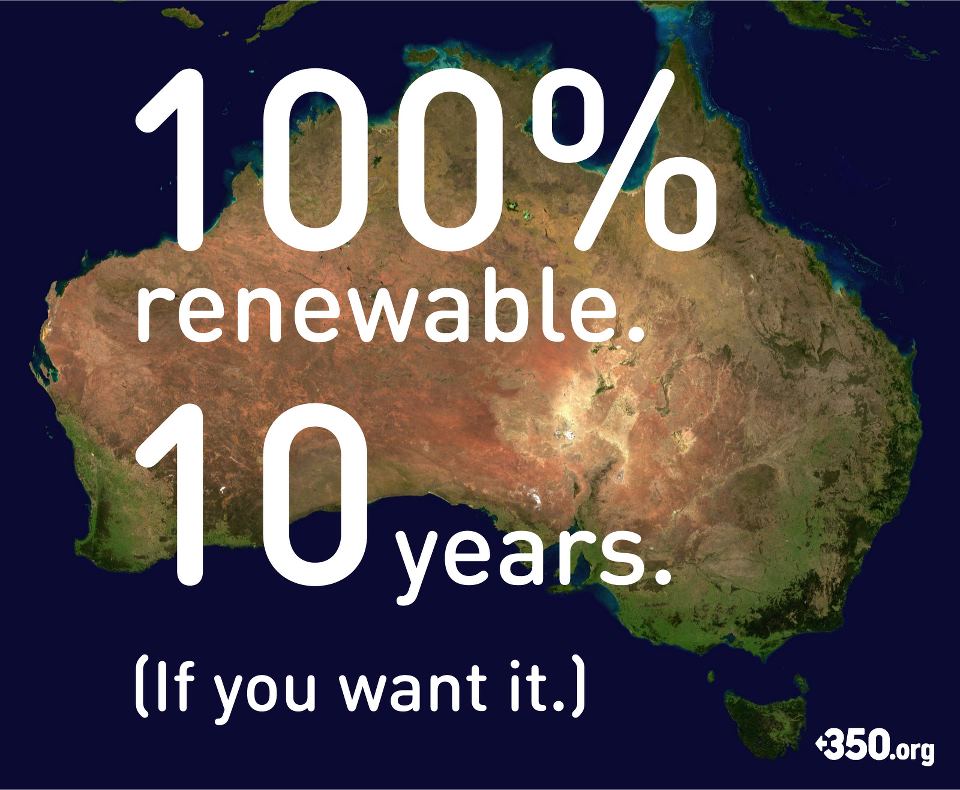
Then there are the things we could do to find alternatives. That means renewables or potentially nuclear for electricity, electric cars, low energy light bulbs (LEDs are good – they come on straight away and are bright).100 Percent Renewables in 10 years - Oz

What is important to know is how much of a change would be needed, at an individual level or wider than that, for us to avoid the worst effects of climate change. What would that look like to you and me. That is something I will explore and write about in the future.

One thing is certain…

Our lives would be completely different.

Worth the risk?

Thoughts below as always.

John Bell,

Ordinary bloke

Woe is Me

In an earlier post I discussed my thoughts as to why people in developed nations are likely to want to ignore the issue of climate change.  Life is comfortable and easy; no-one is starving, so anyone or anything that comes along to disturb that will be in for a short shrift.

Also many of those to whom I’ve spoken about what I am doing have mentioned that persuading people to take action now focusses on the benefits of change rather than the potential risks.

This all adds up and makes sense.

As soon as you try to persuade someone to change what they are doing and have done for as long as they can remember, people will resist.  That resistance will grow further if there is a hint that what they are doing is actually a bad idea.  So it makes sense to avoid that conversation, that impasse, that conflict; to align with people’s values and demonstrate the benefits of change.

But…

While I recognise that as being sensible, I cannot but help think that the pace of change that can be achieved if all that is incentivising us is the potential benefits of green energy and other climate change mitigations, that the pace of change we will achieve will be too little, too late.

From what I understand from reading around the subject, we are fast running out of time to make the drastic changes needed to avoid the worst effects of climate change.  Climate change is already having a profound effect on our lives with only a 0.8°C change, and there is another 1°C to come that we cannot avoid, stored up due to the delay in the climate system.  There are tipping points out there that when reached will mean we lose any chance of redemption.

So maybe the message I should try to push is:

Look how great our lives could be if we embrace these changes – race to adopt new technologies, learn to enjoy each other’s company again and spend our time and money more wisely.  And bear in mind what we are letting ourselves in for if we don’t.  So let’s get on with it, there’s no time to waste.

Thoughts below as always.

John Bell,

Ordinary bloke