Who needs me?

The projects are all moving on, it would seem, in spite of my being busy beyond reason with the business.  More people are getting involved and taking the lead.  My lack of availability has allowed others to take charge, and a fantastic job they are doing as well.

In Berkhamsted, the main projects are Transition Town Berkhamsted (TTB), B-Hive and B-WEL.  B-Hive was the project to find out what the people of the town wanted to see in the centre, which turned out to be more open space, workshops and small business units, plus a museum and performance space.  After an open meeting and a few follow-ups, there is now a slightly wider team involved, setting up a large public meeting to decide what to do next, mapping out the stakeholder groups in the town and drafting publicity to keep the momentum going.  Well done and thank you Jane, Kate, Stephen, Svetlana and Roger for getting back involved.

B-WEL is this new idea to promote the proposed Ecocide law in the town, which was unanimously voted as a good idea by the readers of this blog.  The local paper, the Gazette, are very interested and have asked if we would like to write an article for the paper in Speaker’s Corner, which is usually the stomping ground of the local MP or the Police Crime Commissioner.  I’m hoping that one of the TTB team behind the Ashlyns Lectures will be inspired to write the article.  Go Bex.

TTB itself is on the verge of breaking through, I feel.  There are a number of newly engaged an interested people who are ripe to get involved.  We just need to find the project or projects to hook them.  It is an area that needs my attention, to get the community energy project or Transition Streets up and running.

Slightly more widely, there is the proposed local Transition Town conference.  Having sent out a survey to understand what people would like to see, there is now the job of absorbing that information and booking a venue.  Workshops on community energy, thermal imaging and air tightness gadgets, balancing life priorities, celebration and identifying a unifying strategic intent are waiting in the wings to be organised.  I’ll probably give that a little push.

Then there is the UK and beyond.  The Power Shift UK, part of the Global Power Shift, has now got a few people working part time to make it happen.  Emily has been a star, coming in late on and devoting a large chunk of her time to pushing it along.  The Campaign Against Climate Change, People & Planet, Stop Climate Chaos Coalition and Young Friends of the Earth are now on board, and momentum is building.

And the online platform for challenging misinformation on climate change in the press is on the back burner, awaiting response from the Climate Reality Project.

Of course, all this work has meant that I’ve not seen Rowan and the kids as much as I’d like.  Tell me, is it more healthy to walk for 40 minutes a day or cycle for 10?  I get more out of breath with the cycling.

John Bell,

Ordinary bloke
Invasion

I was interested to read that Nigel Farage made a statement that we should allow refugees in from the Syrian conflict. It raised an underlying question I have about the distant future. Say we are lucky enough to only lose chunks of the south downs and Anglia in the UK to sea-level rise and flooding in the next few decades. Will we close the borders and guard our Isle, or will we hold out a hand of help to those less fortunate around the world?

I have to admit that neither option really fills me with joy.

Say we close the borders. I have to admit that is where I thought those further on the right were going with the increased support for UKIP. Or maybe Nigel Farage is a lefty. Unfortunately, we are at the moment almost totally dependent on the rest of the world for food. And plastic tat, electronic devices and wine. Could that mean we are held to ransom, like a medieval castle under siege? Or if not, we will at least find that there is less to go around and more demand as the world population peaks, and so we will find our sterling doesn’t go as far.

Or we open shop, help out and allow climate refugees in. We are already very crowded. The green and pleasant land will be crowded out with new house building and farming.

The_grass_is_greener_on_this_side..._(4218600060)No, I think we should avoid catastrophic climate change.

John Bell

Ordinary Bloke

PS – you may think that Syria hasn’t got much to do with climate change. You may be right. You may be wrong.

PPS – One of the upsides of a free-market capitalist society is that we are able to choose who benefits from our philanthropy. The victims of the inhumanity of Syria need our help.

Balls Pond Balls Up

Oh dear, does that sound like too much of a tabloid headline? This one is about local government. Who are they serving?

You may remember me mentioning a project I was at one point on the fringes of, to buy a local farm. Well, I decided to stay on the fringes to preserve my sanity and to focus on projects closer to home.Balls Pond Farm

The team in Kings Langley went ahead and have tried to buy it. It is currently owned by Hertfordshire County Council (HCC). So effectively its owned by the public. Already.

So, what should local government do if the public want it as a community farm, low cost housing and a training / conference centre? What should local government do if the public are willing to stump up £1.9 million from their own collective pockets to buy it? Effectively to buy it, I remind you, from themselves.

Turns out they decided to sell it to the highest bidder. It will be interesting to see who that is. Farm land round here is at a premium because of rich folks from London buying the land to keep horses. Is that who has bought the farm? Will the new owner allow the community to use the land?

I’m not going to sit hear on my sofa and say that the decision from HCC was bad, or short-sighted. I don’t know what services they will be able to now provide that would have otherwise been unfunded. I don’t know anything about the new owner elect. I will be very interested to find out.

Depending on the answer to those questions, the finger of guilt may point towards the reasons behind local government being strapped for cash. Is it the policy of reducing the size of government? Is it the policies that lead to are high national debt in the first place? Is it the excesses of the banking sector that lead to the financial collapse? Is the new owner a banker?

There is a parallel with another aspect of local government decision making. Fracking. The blame rests with the Tories for that. Big cuts to budgets leads to impoverished councils. So to then to offer the councils a wodge of cash to allow fracking is a lot like racketeering in my view. Blackmail.

In the meantime, those wonderful people who formed Kings Langley Community Benefit Society have brought the people of their town and its surrounds together. I’ll be very excited to see where their energies take them next. Well done Vicky and Jean-Paul in particular.

John Bell

Ordinary Bloke

What do you think about how bad climate change is?

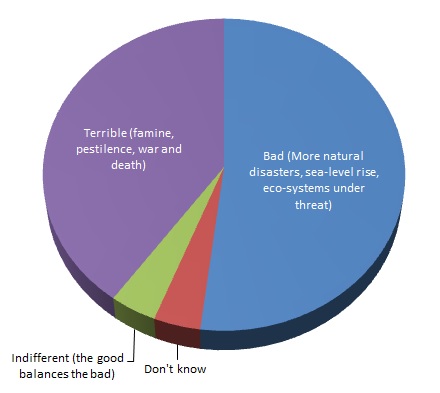
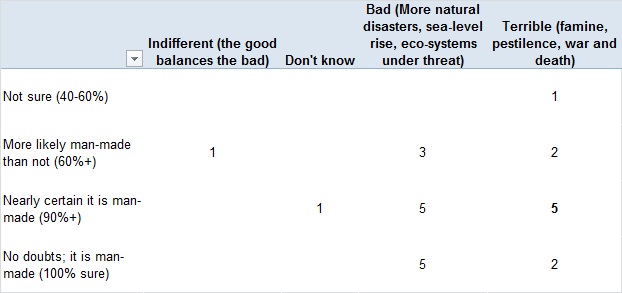
Turns out you think it is very bad indeed. The pre-Christmas survey shows that almost all of you think it is either Bad or Terrible. There are a couple of doubters, and the survey didn’t ask this question of those who didn’t think climate change is man-made in the first place. So, basically, if you think climate change is man-made, you think it is bad.

Team JB Survey - How BadThis is interesting because it means that to persuade someone that climate change is a big problem, all you need to do is to persuade them that it is real. If you are representative. I may be over-generalising. Seems logical though.

I think it is significant that those that are less certain of the reality of man-made climate change are also less concerned about how bad it could be.

Team JB Survey - Certainty vs ScaleSo, what is it that makes someone feel that climate change is terrible, rather than merely bad? The language I used in the survey may be significant. I said that Bad meant more extreme weather, sea-level rise and eco-systems under threat, whereas I used more emotive language to describe Terrible, in terms of the four horsemen of the Apocalypse. I suspect that those who marked it as Terrible, including myself, are more emotionally engaged with the issue.

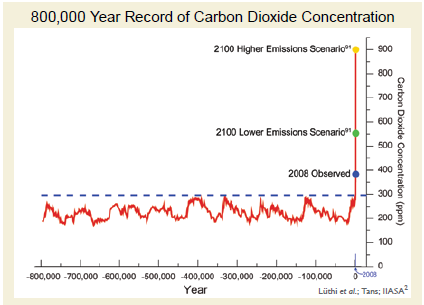
For me, it is the unease I described in my video post that creates that emotion. We are moving out of the natural climactic cycles into something new and unknown, and we are doing so very quickly. The graph below of carbon dioxide levels illustrates the point. When I first saw this graph, I thought the bit at the right had been squished. It hasn’t.

CO2_concentration_800k_years_and_to_2100Why did you put Terrible, or Bad? Or something else?

John Bell

Ordinary Bloke

PS – should I keep calling myself that?

B-WEL

It’s been a highly hectic couple of days. I’ve taken on an urgent job with the business, which kept me away from this blog yesterday. And last night saw the second Ashlyns Lecture. We were very lucky that the lucid and stirring Polly Higgins came to Berkhamsted. She may just have started something.

After setting up a vague horse-shoe of blue plastic chairs at Ashlyns School in the early evening, delivering my co-chair-re-arranger Trevor home, rushing around printing off the list of pre-bookees, I got back to the venue to find our star speaker was already enjoying a plate of the most delicious vegetarian food I’ve ever tasted. I didn’t eat Polly’s, no, I had a plate of my own. Thank you Parul, look forward to seeing you on Masterchef one day.

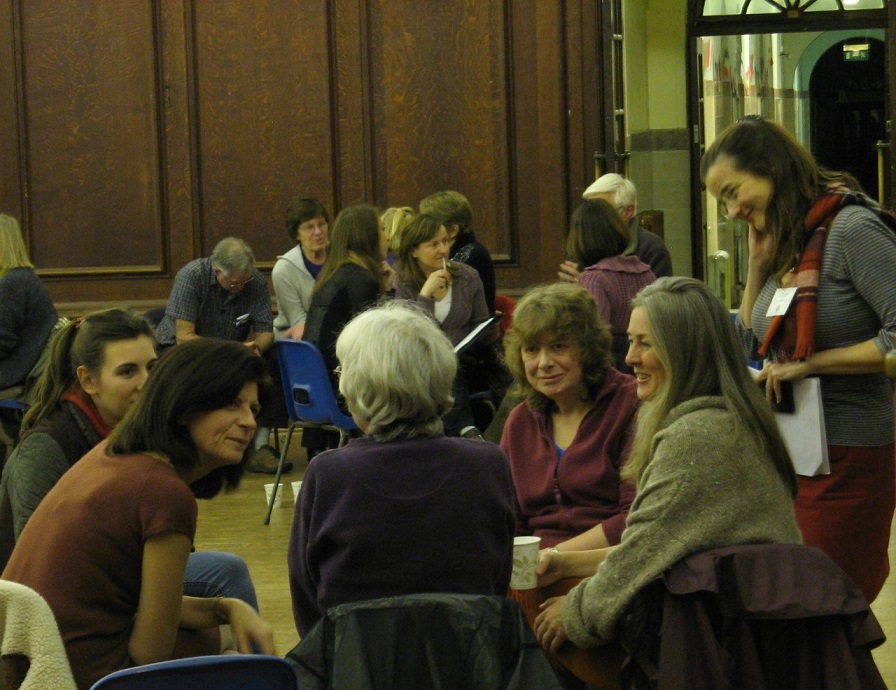
Doors opened at 7pm, and the steady stream started from the off. Food was bought, and it seemed that every other person who arrived hadn’t pre-booked. We’d not put enough chairs out. From pre-bookings of 77, we ended up with a very full hall of 130 enthusiastic folk, waiting to be inspired. They were very much not disappointed.
Polly TalkAfter an introduction from our very own Emma, Polly took to the floor. Without notes or slides, she let her trained barrister skills, natural charisma and deep understanding of her subject flood forward and wash over us. We surfed the rolling waves of her talk as she expertly balanced between emotion and logic.

We heard how, while she was overseeing an injury claim in the courts, she realised that outside there was a neglected and huge victim, laying seemingly passively outside her window. She decided to become the lawyer for the Earth.

That lead her to endeavour to introduce Ecocide as an international crime against Peace, within the Rome statute alongside genocide and war-crimes. It lead her to find out that Ecocide, the intentional destruction of eco-systems, was originally written into those very same international laws when they were first considered in 1972. It lead her to the incredible realisation that they had been dropped suddenly, with unpublicised and secretive discussions at the UN. Three countries had successfully lobbied to have the laws removed in 1996.

Those countries? The United States of America. The Netherlands. And the United Kingdom. In 1996. Under Sir John Major as Prime Minister.

The law can and should be passed. There are 121 countries signed up to make it so. All that is needed for it to be tabled is for one of those countries to put it forward. To do so, they need a mandate from their people.

So it is now our job to create that mandate.

Stroud recently formed Stroud Wants Ecocide Law. Other something like that. Spells SWEL. So we may form B-WEL. Berkhamsted Wants Ecocide Law.

If in 1996 Ecocide had been made a crime, as it rightfully should, the rainforests of the world would now be expanding, the tar-sands in Canada would be a pipe-dream and climate change mitigation would be well under way. Without it? What do you think?

It can happen by 2020. It could happen sooner.

John Bell

Ordinary Bloke

The good about climate change

Climate change isn’t all bad.  Depending on where you do your reading, you may only see the downside.  But there are upsides.  This post examines the three main benefits – warmer winters, longer growing seasons and more fossil fuels.

I’m writing this post because of the reader survey from the end of last year.  One of you didn’t feel able to answer the question on how bad is climate change because you didn’t know about the upsides.

There are three main benefits as far as I can see.  The first two are only benefits in the short-term; the last will keep on giving for centuries to come.

Firstly, at the moment in most of the developed world, there are more weather related deaths in the winter than in the summer.  A warmer world will mean that the average winter will be milder than before, and so cold related deaths will decrease in the short-term and in higher latitudes, according to the IPCC.  There are some important caveats, of course.  Excess winter deaths are higher in milder countries at the moment, so maybe it could go the other way.  And climate change brings with it much more variability, such as the chilling vortex over the US at the moment, which could stretch our ability to cope.  By the way, the frozen US was caused by a very weak and wobbly jet stream allowing a chunk of polar air to descend deep into the south, all as a result of a warmer world.  And of course the lower latitudes are stuffed.Too much to eat

The second benefit is longer growing seasons, again for the higher latitudes.  That’s the UK, by the way.  On average, spring will start sooner and summer will be longer over the next few decades, so we will be able to grow more food.  In fact, in the short-term, there should be an overall global increase in food productivity, again according to the IPCC.  Longer term it goes the other way, of course, and the lower latitudes are again the losers throughout.  And in some years, due to flooded summers or droughts, we will have to wait for the next year to eat.

The final benefit I’d like to talk about is the receding ice-sheets exposing more land and sea, for food growing, travel and of course for fossil fuel extraction.  Greenland, here we come, and we can start drilling in the Arctic.  Like a smoking amputee reaching for another packet of cigarettes because of their unrelenting addiction.

So, all in all, in the next few decades, the richer people in the more northerly or southerly parts of the developed world will probably benefit from some domestic improvements.  Will we be better off in that time, as the rest of the world withers away?

And will we be able to enjoy our spoils, with the knowledge that we have pushed the world out of its natural cycles into something new and unknown, with the inevitability that it will be coming to get us when we are old and our children are struggling on?

John Bell,

Ordinary bloke

Me, my family and out from there

Where am I?  This post is an update on all the various projects I am trying to keep afloat.  I have a little too much on.

Some deep thinking over the Christmas period, while North Wales was battered with 100 mph gusts, has lead me to conclude that I need to prioritise from the inside out.

What does that mean?  It means I first need to make sure I am taking care of my inner self, then my health, then family, friends, home.  After that I can start to look at my local area, town and then further afield to the rest of the UK and abroad.  Unless I take that approach, anything I do that reaches too far from myself will be built on shaky and uncertain foundations.

So, what I should be doing is training myself to be in the moment, with a grounded understanding of where I am pointing.  Then making sure I get enough sleep, a decent diet and exercise.  I’ll give myself a 5 out of 10 for that – too many late nights, not enough exercise and ending up ahead of myself all too often.

Family life is fun and fulfilling at the moment.  Rowan and I are in a very good place, and the children are a laugh a minute, while still growing fast in all regards.  Little James is enjoying standing, not yet walking.  I’d like to spend more time with them.  8 out of 10 for family.

Rowan and I are trying to sort the house out, with a major, if slow, de-cluttering exercise underway.  An aversion to waste has lead us to hoard leads, toys, magazines, off-cuts, you name it.  So we are trying to be ruthless in clearing it all out.

In Berkhamsted, there is the B-Hive project as well as the Transition Town.  The B-Hive is the community initiative to give a voice to the people of the town to have their say about how it develops, and is now becoming the vehicle to help deliver those needs.  After a town consultation and a 96-page report, we’re now lobbying local government and building up the capacity of the team.

On 22 January, Transition Town Berkhamsted (TTB) are hosting the second Ashlyns Lecture, with the incredible Polly Higgins coming to the local secondary school.  Polly is one of the top 10 most visionary people in the world according to the Ecologist, and I am looking forward to her visit.  We’ve been out at the market raising awareness and selling tickets.  Book your place now!

Next steps for TTB are to identify a big project or two to rally the troops around.  My preference would be either community energy or Transition Streets.  I’ll give myself a 7 out of 10 for the local town.

Beyond that, I’m organising two conferences.  The first is for the dozen or so Transition Towns in the area, so we can share our stories and ideas.  The second is the UK Power Shift, part of the Global Power Shift, which links strategically in with the UK climate movement.  The aim of the latter is to link the climate change activity in the UK with each other and to the rest of the world, so we can all feel part of a major movement towards a more responsible future.  I’ll give myself a 7 from 10 for UK and abroad, but this could slip if we don’t get more support.

Oh, and there is the ongoing idea of creating an online platform to allow people to challenge the misleading climate change articles that appear all-too-often in the press.

In general, I’m wanting to build up the number of people involved in the projects in the local town, UK and abroad.  I don’t want to see any of the initiatives collapse, and so I’m trying to make sure there are enough people behind each before I can start to take a back seat and concentrate on one or two priorities.

John Bell,

Ordinary bloke

Why do I find climate change so unnerving?

I made a video.  Rather than the usual written blog, I’ve had a go at talking over some pictures.  I want to get across why climate change so unnerves me.

In a nutshell, it is because we are forcing the climate of the world out of its natural pattern and into something new and unknown.  And when people do try to figure out what we are letting ourselves in for, it is mostly bad news.

Anyway, see if this video does it for you.

OK, I’m sold. Fracking = bad idea

A few weeks ago, I wrote a post comparing fracking, wind and nuclear as potential sources of domestic energy for the next few decades.  This video of Kevin Anderson has me pretty convinced now, that fracking is a bad idea.

At the time of writing the comparison post, I was not convinced – I thought a combination of all would probably be the way to go.  With the revelation that fracking would only really take off after 2020, when we need to be well on the way down the emissions lowering trajectory, I realise that fracking cannot form part of the energy mix if we are serious about keeping to a 2 degree or lower temperature rise.

Watch the video yourself, let me know what you think.

John Bell,

Ordinary Bloke

If it’s not us, what is it?

A few weeks ago, I put a survey up on this website to find out what you think about climate change.  85% of you think recent changes are predominantly man-made, but a small number thought it was definitely, 100% natural.

For those who said recent climate change is natural, the survey took a different path.  There was not much point asking people how bad they think climate change is if they don’t think man has anything to do with it.

I asked what you thought the cause of climate change was, if it wasn’t humans.

Given the options of “Nothing – the globe is not warming”, “Sun-spots”, “Volcanoes”, “Natural cycles other than the above”, “No-one knows for sure” and “Other”, every single one went for “Natural cycles other than above”.

Well, that’s not strictly true, one person went for Other – “Natural cycles, including Sun-spots, Volcanoes and gravitational shifts within the earth core”.

They were all very certain about it not being humans.  If you are reading this, please do contact me or return my email and let me know why makes you so certain.

The survey effectively ended there for these people.  There is nothing more to say.

For the rest of you, though, there was much more to find out.  As concluded by a recent RSA report, it is not the small minority of deniers that need to be convinced to act, it is those who do accept man-made global warming, but choose not to do anything about it.

John Bell,

Ordinary bloke