It’s not just me

It’s not just me.  There are people and groups active all over the country creating a more caring society.  A week ago Sunday, I organised for people from 11 different Transition Towns in my area meet to work out how we can help each other.  I kept getting thanks for setting it up, although it was so simple to put into place I felt a little bit of a charlatan.

The story starts late last year, when four mature students from Ashridge Business School did a project to help a local organisation get more organised and strategic.  We were very grateful that they chose Transition Town Berkhamsted (TTB) as their subject.

After spending time interviewing members of TTB and talking with other Transition Towns, they put together a presentation to let us know their findings.  They told it to us straight, about how far from being well organised we were.  We needed to be clearer about our vision and strategy, have a decent communications strategy and get serious about funding.  While on the one hand this was not easy listening, on the other it gave me confidence that we were heading in the right direction.

One particular recommendation they were keen on was to form closer ties with the Transition Network and with other local Transition Towns.  Together, we could potentially pool resources and get an office or hire someone.
Transition Town BBH - gathering in motion
So when Andrew Davies and Lena Sunblad offered to facilitate a meeting on any subject we pleased, the natural choice was to get the local Transition Towns together.  I felt slightly guilty about the enthusiastic thanks I got at the end of the day as it had been so easy.  The facilitator was already in place, the resplendent Box Moor Trust venue fell into my hands thanks to Marion Baker organising another workshop on local food (“Best Food Forward”) and the attendees almost invited themselves.  That only left getting the marker pens and colourful post-it notes.

Abbots in Transition, Change4Chalfont, Haddenham in Transition, Hemel in Transition, Low Carbon Chilterns, Transition in Kings, Transition St Albans, Transition Town Letchworth, Tring in Transition and Winslow Transition have all achieved a huge amount in the past few years, from apple presses to solar farms, orchards to thermal imaging cameras, guerrilla gardening to recycling for fetes.
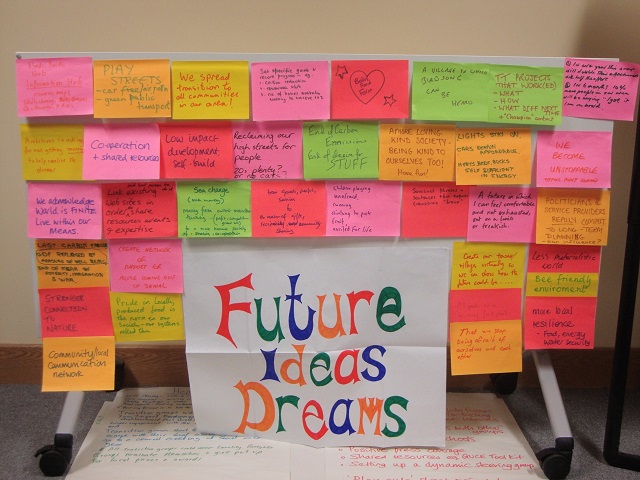
Transition Town BBH - Ideas
The baking skill that went into those delicious cakes that everyone brought was something to savour.

We will hold another gathering in a few months’ time, and in the meantime will share with each other where we have templates for starting community energy projects and event recycling as well as physical gizmos like a bike with a smoothie blender attached.

I will be following up with Mike Thomas at Transition Network about how they can help with this process, such as using their website to share resources or assistance with setting up a regional conference next time.

It is uplifting to realise the number of people who are actively creating the inevitable new normal, where happiness, fulfillment, kindness and love are more important than the endless chase for more stuff and more money.

John Bell,

Ordinary bloke
Byd Bach Tew

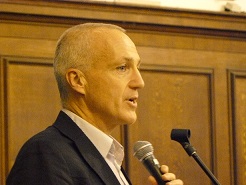
Last Wednesday we held the first ever Ashlyns Lecture.  Here’s hoping they will become famous.  The speaker was Professor Ian Roberts, author of the acclaimed book Energy Glut.  And when talking with Ian I discovered one of those incredible coincidences that seem almost unreal.
Ian Roberts giving inugural Ashlyns Lecture
Transition Town Berkhamsted have been forming a partnership with the comprehensive secondary school in the town, Ashlyns: Hence the name of the lecture series.  We are going to be holding three of these talks per year, one in each school term.

A few short weeks of hectic meetings over a bowl of crisps, putting posters and Facebook posts culminated with about 100 people making their way up the hill to the school to hear Ian Roberts talk about his book and research.  He co-wrote the book with Phil Edwards, who happens to be a childhood friend of one of the members of my curry club, Nick.  I’d met Phil sitting round a fire at Nick’s 40th, although neither of us was in a fit state of mind for a sensible conversation.

But that’s not the coincidence.  Before the lecture started, I had a chat with Ian about his slides, which were resting on my laptop.  One of the slides showed a rather harrowing picture of a child war victim, which we agreed to drop.

“I hear you’re from Anglesey” Ian quizzed.

“Yes, I was brought up there.  How did you know?” I replied.

“Bruce mentioned it over dinner,” said Ian – he’d eaten earlier with the main man behind the Ashlyns Lectures.  “Where did you live?”

“Beaumaris.  Do you know it?” I asked.

Ian stared back at me with a look of surprise.

“That’s where I grew up!” he revealed.

Turns out we went to the same primary school and both went to David Hughes secondary school in Menai Bridge, if at different times.  Talking of Beaumaris Primary, I asked whether he remembered any of the teachers.  How about Mrs Thomas?

“Yes!” he said, with a characteristic drawn out pronunciation.  “The one with the big hug!” he mimicked a very recognisable bear hug that was unmistakeably Mrs Thomas.

We didn’t have time to reminisce further, as I was rushing about getting water and welcoming the audience, and he needed to refresh himself of his slides.

The talk started with Ian describing the subject of his very accessible book, which shows how our full roads lead us to increasing levels of fatness and are curtailing the freedom of our kids.  He described his motivation for writing the book.  It stemmed from the guilt he felt when once he promised a young girl that she would be OK after a horrific car crash.  He then put her under for an operation that she didn’t survive.  He is a medical professor, you see.

It seems obvious now.  As we drive more, we move less, which is making us fat.  We drive more still, because the roads are too dangerous to walk or cycle, and we’re able to carry more food home, so we eat more as well.  Our children cannot roam freely and are being brought up in a world where you stay still more than you run about.  We’re talking world society as a whole here, not just the UK – in general we are all moving less, driving more and getting larger.  And of course, all those extra car journeys are contributing to climate change.

Ian and Phil have written papers on the financial, individual and societal benefits that would result from more people walking and cycling.  A relatively modest shift would lead to thousands of fewer deaths from cancer and heart disease, which would be a great saving for the NHS.

One interesting factoid was that for someone over 40, the extra years of life from the fitness gains of cycling far outweigh the risks of injury.

I’m getting a bike for my birthday.  Today.

Following up via email the following day, I thanked Ian for his excellent talk.  It turns out that not only did we grow up in the same village, but our parents are still in the same village and know each other well.  My mother and his father are both on the board looking after the Canolfan in Beaumaris as the townspeople take it over from the council.

Byd bach tew.  Small, fat world.

John Bell,

Ordinary bloke

Kids taught me another lesson

Maddie reminded me again on Saturday how much I can learn from my kids.Kids in back of car

We had just spent a pleasant, lazy afternoon in town having a late lunch, exchanging books in the library* and buying marker pens for a gathering of Transition Towns the following day**.

I’m afraid to admit that we’d driven to town, even though it is walkable.  It was the lazy option, both mentally and physically.  You need to be organised to live a low carbon life.  We had no food in the house and had left it too late to walk.

We’d arrived back home, and Rowan was getting the buggy out of the boot, and I was trying to manage a little tiff that Maddie and Emily were having while still strapped into their seats in the back of the car.

Maddie was reading the blurb of the three Enid Blyton books she’d got out of the library.

“If you don’t give me one of those books, I’ll punch you again” threatened Emily.  She slightly lisped the “ch” at the end of “punch”.  “And if I ask you and you don’t give me another, I’ll punch you again”.

There followed a typical little exchange between the two of them where we established that Emily had indeed been the aggressor.

“But it was very lightly” Emily protested quietly.

To be fair, it probably was.  It’s difficult not to laugh when she gently closes a door in a fit of pique.

“You might need to go on the naughty step if you don’t say something to Maddie.  What do you think that would be?”

“Sowwy Maddie” she apologised.

“It’s not good to punch people if you want something.  Then again, Maddie, it would be good if you could share with Ems.  If she asks nicely for a book, maybe you could give her one?”

“Please can I have one of your books?” Ems asked, eyes turned downwards.

A book was handed over, Maddie hanging her head as well.

“I think that if you both treated each other as though you love each other you’ll both be happy,” I said, veering into preachy mode.

Still looking at her feet, Maddie said “Daddy, I think Mummy would be happier if you helped her with the boot”.

Game, set, match small people.

I got out of the car to help Rowan.

John Bell,

Ordinary bloke

* I took “Prosperity without growth” back without opening it – not had time – I’ll get it out again when I’ve finished “The Long Earth”

** 22 people from a dozen different local Transition Towns are gathering (have gathered by the time this goes live) talk about how we can work together.  In a classic example of “build it and they will come”, a friend Andrew Davies, author of the Future Café, had offered to host an event for me for free, on any subject.  The idea of getting the local TTs together came after we’d decided to have a meeting.  I’ll write a post about it soon.

How I did it

Rain was forecast.  It didn’t surprise me that the sun was high in the sky.  It was a friend’s 40th and we were on a circular stroll through the ancient Ashridge woods, from and to the homely Valiant Trooper in cossetted Aldbury.  Lovely food.  A friendly conversation with a couple I’d just met lead me to realise I’ve not covered how I reduced my emissions in this blog.
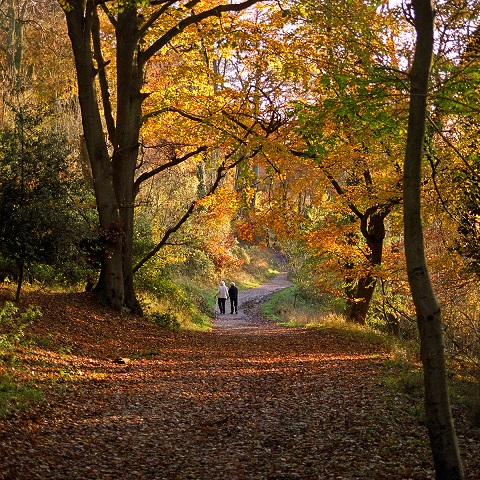
Colours of Autumn | Ashridge Park, Hertfordshire, UK | Autumn vi
I was chatting to Will and Anne, friends of the birthday boy.  I’d barely had time to christen them “Will-I-Anne” (oh, I am a funny man) before we got on to the inevitable subject of what we each “do”.  Will is a TV producer and Anne a financial solicitor.  I had more trouble describing what I “do”, but inevitably it lead to a discussion about climate change.

I described this blog and how I’ve been trying to show that a low impact lifestyle is thoroughly fulfilling and worthwhile.  They asked the obvious follow-on question – what would I recommend that they do to reduce their own emissions?

For me, it’s been a roundabout journey.  I guess it really started only a handful of years ago around the time I got involved with Transition Town Berkhamsted.  I was concerned about climate change but hadn’t really made any concerted changes in my own lifestyle.

It was probably setting up and running an Eco-team that kick-started me into action.  The idea is for a few friends to measure their energy, petrol-use, gas, water and even to weigh your rubbish and recycling, and then to progressively look at reducing each in turn.  We’d go through a few hints and tips for each and implement them.  I learned about the 10-second rule for idling cars, put a hippo bag in my toilet cistern, got a new boiler and the solar panels installed, started using washable nappies (not me, the baby), and looked for produce without packaging.  I saw a huge decrease in my consumption – of about 30-40% for each of gas, electricity, water and rubbish.

So first step I’d recommend would be to measure your foot-print to find out where the major problem lies.  It’s the same way a business might approach the job of reducing costs or a computer programmer might look at making a process more efficient.

Once you’ve worked out what the big hitters are in your lifestyle, you’ll need to work out how to cut them out.  It is likely though that the biggest changes you can make concern your travel habits and how much stuff you buy.  One holiday at home rather than flying is going to be worth an awful lot of recycling.

Don’t get me wrong, I did make those obvious little changes that save money and avoid waste, such as getting cavity wall insulation or replacing high-energy light-bulbs.  That’s just not the whole job done, by any means.

Turned out that Will-I-Anne had made quite a few changes in their lives already, but were not convinced that making further changes on their own would be worth it – they argued that it needed central co-ordination from government rather than individual action.  Though they did amiably agree that just because government aren’t forcing change does not devolve you of responsibility.

In the end they decided that they would offset for their remaining big emission habit – flying to Oz to see relatives – by paying someone to sequester some carbon dioxide for them.  While it would be better to avoid the emissions altogether, at least this will mean that their emissions now are lower than they would have been.  If everyone offsets the capacity for offsetting will be reached and the price will go up, then they will need to look again at their habits.

I hope that helps.

John Bell,

Ordinary bloke

I’m not standing for it any more

Does anyone believe what they read in the paper without checking around?  I reckon we generally do if it sounds like something we want to believe*.  Unfortunately 80% of articles in Murdoch owned media are misleading on climate science, from emphasising the short-term trends when it suits to giving a platform to outright deniers such as Nigel Lawson or James Dellingpole.  It may be pissing into the wind, but I’m going to try to do something about it.  Have a look – do you think this is a waste of time or could help move opinion and attitudes?
Media tycoon Rupert Murdoch addresses a session of the World Economic Forum in Davos
I mentioned in a recent post that I have been in touch with a number of organisations about my idea of opening up press complaints around climate change to the public.  So, this is what I’ve been up to.

The idea has evolved following conversations with John Cook at Skeptical ScienceAvaaz, The TreeFriends of the Earth International, The Climate Reality Project, the UK Press Complaints Commission and with Bob Ward of the Grantham Institute.

I sent them an email describing where I’ve got to, below:

Idea as it stands

A web page will be put together (host to be agreed, possibly Climate Reality) allowing members of the public to identify press articles that appear to be factually inaccurate, misleading or biased on the subject of climate change.

A volunteer base will be set up to:

[1] List the inaccuracies, bias and misleading content, with reference to a database of the scientific facts (e.g. that of Skeptical Science in Australia, the Carbon Brief in the UK and/or Media Matters in the US).

[2] Draft an official complaint template letter to the relevant independent authority.  In the UK this would be the Press Complaints Commission.  The scheme would start with the US, UK and Australia but could be built with a mind to opening this up at a later date.

[3] An expert volunteer would check the template letter and list of inaccuracies.

The public would then be asked to write an email to the editor, facilitated by the site, with their own personally written content.  Bob Ward of the Grantham Institute said that he thought that this would work.  If the emails are identical, they will be ignored, and similarly if there is only one purporting to represent a lot of voices.

The site would also collect individual public endorsements of the template complaint, and allow comments with a view to updating the content if necessary.

If the editor has not agreed to publish an apology or redaction prominently, then after a few weeks and before the time limit relevant to the local press complaints body (2 months in the UK) the template complaint will be submitted to that authority and taken from there.

The number of people who sign up plus statistics on numbers of biased etc articles by paper could be published online.

Benefits / outcomes

The main benefits and hoped for outcomes would be:

[1] Reference point for each article for the truth.

[2] Actively engage and empower more people to be able to speak out.

Background about complaints to the UK Press Complaints Commission

On speaking with Simon Yip of the UK PCC and with Bob Ward of the Grantham Institute (who has raised 5 complaints in the past), I understand the following about the procedure in the UK:

[1] The PCC look for the complaint to be dealt with in correspondence with the editor, possibly facilitated by them.  It is only as a last resort that a complaint is taken forward.

[2] If an article is identified as opinion and acknowledges there are other different points of view, it will generally not be upheld if it gets that far.  If the editor offers to print a letter from the complainant then that will be seen as sufficient.

[3] If there are several complaints, then one will be chosen by the PCC at their discretion to represent all of the others.  They will judge this based on whether all of the points are covered and whether they feel they will be able to work with and reach a compromise with the complainant.

[4] The total number of complaints has no bearing on the outcome and is not reported by the PCC.  Or so I was told.  You can understand my surprise when the total number of complaints on the Daily Mail article about Ed Milliband’s was announced on Newsnight.

Do you reckon it could work?

John Bell,

Ordinary bloke

* As a little aside, a little tongue-in-cheek anecdote about someone trying not to let their own predication influence their thoughts – this from my brother, describing his new flat in Qatar:

So it’s a bit more comfy, plus there’s beer in the fridge for me, a rice cooker for Noy and a cupboard of new toys for the little one (and for me actually; I’ve been itching to get stuck into that lot! I remember one time in Kuwait, when the ladies were in Thailand, I still ended up racing two cars across the tiled floor – good fun! And no one could beat the silver car because really I didn’t want it to lose, and tried to convince myself that I wasn’t pushing it just that little bit harder… and if you just angle it slightly into the other car, the other car might just spin off a little bit and go under the cupboard; and wehey! Silver is champion again!)

Quick thought from my daughter

I thought I’d share some words from my daughter Maddie (aged 7).  It may sound as though she’s got this from me in some way, but I can honestly say that I had no involvement.  Other than to send her to a religious school because we wanted her to pick up strong moral teaching.  We’re not religious ourselves – as I’ve mentioned previously I’d describe myself as an active agnostic.

The children at her school were all asked to write a prayer for the harvest service at the local church.  Hers was selected as one that will be read out.

Without further ado, here’s over to Maddie:

Dear God

Help and raise enough money for Ethiopia to have more food.  Help all the farmers to collect more honey and let them have more equipment.

Sorry that we are not being fair enough.  We are working on it.  Please help the farmers to harvest their crops.

Amen

John & Maddie Bell,

Ordinary dad & extraordinary daughter

Less work means more

Funny how life works out, isn’t it?  The business is going through a lull, resulting in more time for organising a workshop for Global Power Shift, getting the next steps on the B-Hive sorted, developing an idea for tackling misinformation in the press and moving to a farm…

An email went round in my business circles recently, stating that the Department for Transport had identified a potential problem with the software I have specialised in.  I felt a little down for a few days, as the work dried up, but realised what an opportunity had opened up.  I now have a few weeks of time on my hands to devote to the other aspects of my life.  The opportunities for the climate change work are opening up.  Glad to have more than one iron in the egg basket.

The disparate group of young activists involved in the UK team of the Global Power Shift are starting to get organised, and I’m giving as much support as I can.  Would you believe I am almost the grandad of the group.  I am helping organise a weekend away to allow them to spend a decent amount of time together to develop the general direction of opening up the climate change movement to a more diverse and non-traditional cross-section of people in the UK and to sort out their own governance.

The date for this weekend is 26/27 October, which coincides nicely with a trip to Wales to see my folks.  We’ll be taking the kids to a Halloween party at the Leisure Centre my mother is running in her retirement.

With Transition Town Berkhamsted, we’re starting a series of talks called the Ashlyns Lectures.  They will be one per school term at the local secondary school.  We had comedian Mark Stevenson lined up for 5 Feb, but then had the opportunity for Polly Higgins to come in during late Jan, which seemed a pity as it would be too close to Mark’s talk.  But as luck would have it, Mark had to postpone, which opened up the door for Polly.  The real coincidence was that Mark suggested a revised date for his talk, which happened to be the already-booked provisional date for the third Ashlyns Lecture on 21 May.  Thank you Mr Fate, whoever you are.

You may have noticed that climate change is getting more press recently, in the run up to the release of the 5th IPCC report on 27 Sept.

Don't let them do it to you

Don’t let them do it to you

  This has led to a spate of factually inaccurate, misleading and biased articles appearing in the primarily Murdoch-run papers and news channels.  We shouldn’t allow this propaganda to get out there unchallenged.  While jogging in the woods it came to me that we could set up an easy mechanism for people to make official complaints about these articles, based on the science.  It’s early days, but conversations with John Cook at Skeptical Science, Avaaz, The Tree, Friends of the Earth International and The Climate Reality Project seem to be going somewhere fast.  Watch this space.

The lull has also offered me the chance to organise the next steps on the B-Hive town consultation I have been involved with.  The architects are meeting tonight to pull together the ideas of the townspeople.  I’m also setting up a meeting of all of the Transition Towns in the area to get ourselves organised – that’s 20 Oct.

Then there is the potential community purchased of Ballspool Farm in nearby Kings Langley.  I’ll get involved with that if it looks promising enough, to help lead to my dream of creating a self-contained community of like-minded individuals which treads lightly on the environment but is also capable of living through any kind of breakdown in society.  Yes, that could easily happen.

John Bell,

Ordinary bloke

My Life

So, John, what do you mean by a low carbon lifestyle?  Sounds like austerity gone mad.  Must be very boring.  How about I tell you?

Most mornings, I get up early, leaving my wife snoozing in bed and the baby snoring in the cot.  Sometimes, my eldest daughter Maddie has woken up early as well, and has been reading in bed.  I get her started with her breakfast, before heading out for a jog into the woods.

Early morning

Early morning


I sit for a few minutes under a tree, enjoying the sounds of the natural world, before jogging back home for eggs on toast and a cup of black coffee.

Then there is a little frenetic activity as we get the children up and ready for school.  Occasionally I accompany Maddie and Emily on their walk to school, sometimes my wife Rowan has the honour.  If it’s me, it’s likely I’ll be walking back via a farm shop to buy some locally grown eggs and veg, which are cheaper than the supermarket.

Walk back from the shops

Walk back from the shops

I’ll then settle down at home for a day of work, powered by the sun on my roof. That will be a combination of work for my business, organising things for the Transition Town or Global Power Shift, or maybe illustrating or writing if I’m feeling creative.  On the odd day I’ll get the train into London to meet with my business partner or a client.

I might help myself to the odd cup of tea or biscuit during the day, and lunch is a relaxed affair with Rowan and the baby.

Up to twice a week, I walk into the town rather than work from home.  On those days, I work from a friend Bridget’s loft.  We swap skills – she helps me with my writing, I help her get her computer glitches sorted out.  On the walk back home, I might go to the local butchers to pick up some ham or sausages.

While I’m out and about, I might spend some time on the allotment digging, harvesting or weeding.  I don’t do as much of that as I should.  I can catch up with work in the evening if I decide to spend more time outside during the day.

I’m then home early to help with an early evening meal and to get the children to bed.  A few days a week I might go out to a meeting in the evening over a glass of wine at someone’s house, or over a pint in the pub.  Red Squirrel or Side Pocket are decent.  On other days I might watch a film with Rowan, or catch up about the day.

Out and about - with the Snake Tree

Out and about – with the Snake Tree


The weekends are similar to the weekdays, but with the kids around.  We’re likely to go for a walk / bike-ride in the woods, or go up to Whipsnade for a little while (this involves the car).

For holidays, we might go up to my folks on Anglesey in North Wales or up to the in-laws in Shropshire.  This year we also went to what proclaimed to be a low-carbon cottage in the Cotswold Water Park, just south of Cirencester, for a week of sun, swimming, tennis and scones.

Holidays - James with Aunty Lau

Holidays – James with Aunty Lau


How does that sound to you?

John Bell,

Ordinary bloke

Habits

To some it might seem a little crazy that I’ve jacked in the permanent job, don’t fly and forego the convenience of the supermarket to buy more local food.  When I tut while someone’s car idles as the driver runs back to their house for their purse, I have to remind myself that I did not always think like this, and it has taken years for my attitudes to change.  Yours may change too, given time.Crazy

Not very many years ago, I wanted to fly around the world and visit every corner.  I flew to the south of Spain for a golfing break, for goodness sake.  I flew to Canada for a snow-boarding holiday.  I flew all over the place.

When I first learned to drive, I used to tear around the lanes of Anglesey as fast as I could.  Seems ridiculous now.  After a few points on my licence for overtaking on chevrons, my attitude changed.  I then made a point of driving at the speed limit.  I’d leave a 30 mile and hour area to de-restricted and would accelerate as fast as I could to get to 60.  I’d make a point of driving at a constant 80 on the motorways (everyone did – they were talking about changing the limit in any case).  Idiot.

I don’t think there was any particular moment when I suddenly became aware of the carbon emissions I was causing.  Over time, I have changed my habits, one by one – it’s kind of crept up on me.  I haven’t flown for years.  I drive at 60-65 max.  I take the slower, direct route rather than nip onto the A41 and zoom down the dual carriageway to get to Hemel Hempstead.

I’m sure my attitudes and habits on other things will change over time as well.  Vegetarianism, here we come.

It has been a slow accumulation of knowledge and understanding that has lead me here, such as reading a lot of New Scientist articles, being part of Eco-teams and finding out lots of useful titbits (such as the 10 second rule for switching off your car engine).

My point is that I should not get angry with others when they do what I used to do – they’ve just not yet been on the journey so they are aware of what they are doing.  And my point to you, the reader, is that you are likely to go on that journey as well.

Talking to a friend Steve about this yesterday, he commented that his habits are slowly changing.  “Baby steps”, he described it as.  He now will choose the UK tomatoes rather than those from Holland, for example.

Some of you will probably be reading what I do now and think I am a bit of a lunatic.  I hope you will remember to look back at this in 10 years and compare with your attitudes at that time.

John Bell,

Ordinary bloke

Sorry Shelly and Beepy

I have had some communication with Shelly and with Beepy, the characters from the oil industry mentioned in the last post.

First of all, I would like to say sorry publically to the two of them, as I should have given them the opportunity to comment on the post before it went live.  They are friends whose trust I have abused which I regret.  Shelly likened the episode to tabloid journalism, and Beepy thought the post was inaccurate and biased.Mocking_Bird_Argument

I have changed some of the wording in the last post in light of their comments – to correctly attribute a quote, and also to make it more clear that the direction of my ire was towards the decision makers at the big oil companies, and not Shelly or Beepy themselves.  I will change it further once I understand from Beepy how the article was biased or inaccurate.

The main points that Shelly wanted to make in return was the economic reality of the stance that Shell have relates to the need to remain competitive in the market, and that among the oil companies Shell are leading as much as they can.  I will write a further post with more detail on their points.

I’d like to thank the two of them also, as I believe there is a more fundamental lesson for me here.

Earlier today, while walking along the canal tow-path near where I live,  I was thinking about Shelly’s comments.  I realised that my reason for writing the previous post, and for not checked it with them, was because I was looking for someone to blame for the hole that we’re in with our changing the climate: a hole that we seem intent on digging deeper.

I thought maybe I would write a further post on it.  In a few decades time, who will be held responsible?  The politicians for not regulating or providing the right incentives?  Big business for seemingly not having a conscience?  The media for misleading the public?  The public for being causing the ultimate demand for fossil fuels?  Activists for unintentionally antagonising and pushing people into entrenched positions?  Scientists for not giving us a straight answer?

Truth is that we are never going to solve the problem by looking for someone to blame, or taking the blame ourselves.  All of the above are very unfair statements to make.

Maybe a more productive direction is to ask a very different question: Who is in possession of the solution?

In all likelihood there is no one solution out there waiting to be found.  In fact there many possible solutions, and all of the scientists, activists, public, business, politicians and media are in possession of the clues to the combination lock that will take us forward.

Maybe my contribution to finding the answer is to help change the question.

John Bell,

Ordinary bloke