No help here, oh dear

So, we met with the UK Exchequer Secretary to the Treasury (Mr Tax), MP David Gauke.  As promised, we talked to him about shale gas and how its exploitation is incompatible with keeping global warming to less than 2º Celsius.  My conclusion after the meeting is that the current UK government will not back up its rhetoric with equivalent action – climate change will not be addressed.

The surgery was running late, so Danny Bonnett and I had a chance to practise our arguments beforehand, while sitting outside the Berkhamsted Town Council offices.  We would also mention the risk to our pensions that continued investment in fossil fuel exploration and extraction brings, as raised by the UK Environment Audit Committee recently.  We’d also discuss how the UK renewable energy sector is stagnating due to government planning policy.

We then went in, got through the formalities and the conversation stated.  I read the recent quotes from David Cameron and George Osbourne that climate change is serious, man-made and something we should do what we can to address.  I stated the evidence that current targets gave us a less than 50% chance of avoiding the 2 º Celsius rise in temperatures.

David started by saying how the US has reduced its carbon emissions by more than anywhere else by moving over to shale gas.  He backed down from that argument after I pointed out that the US had a coal-based electricity generation network before they switched to gas, whereas we already have a gas-based system, so we won’t get the same benefits.  Plus we are starting 10-20 years later than the US – the remaining carbon budget is much lower now than it was then.

He did seem very interested in Danny’s first-hand accounts of how the UK renewable energy sector is on its knees at present due to uncertainty.

But his main argument for continuing with government policy was the need to keep energy bills down, particularly for businesses, and to do so in a way that was politically acceptable.  I.e in a way that would help them get re-elected.  Whereas shale gas is controversial, they think it is low-carbon (it’s not) and they think it is less controversial than onshore wind-farms.

They are evidently not going to take a strong stance to persuade the population that it is worth paying to replace our dirty power stations with renewable energy.

So, where does that leave us?  For meaningful action on climate change, at least a couple of Business, Government, Media and the Public need to make seismic changes to change our attitudes and to reduce our greenhouse gas emissions.  I know some think that they are within their moral rights to live as they please, and there should be incentives in place to make sure that our actions are acceptable to society.  Or that there is no point in making changes in their lives if the majority do not do similar.

Well, the Government is not going to bring in those incentives.  The media continues to serve all opinions on climate change, whether scientifically valid or not, so the public will be able to find a way to justify denying the problem or that they can be part of the solution.  Business will aim for profit, and the Government will not be incentivising sustainable practices to a large enough extent.

So, the only way through is a revolution.  Society as it stands cannot cope with climate change.

Or get those kids trained in survival skills.

Or maybe we all need to take responsibility for our actions, and reduce our own emissions.

John Bell

Ordinary Bloke

Here we go again, another press complaint

Encouraged by the results of my survey, I am embarking on another press complaint.  I know I said that press complaints appear to be very difficult to be upheld.  I also said I wouldn’t draw wild conclusions from the small, biased sample that my survey represents.  Hey ho.

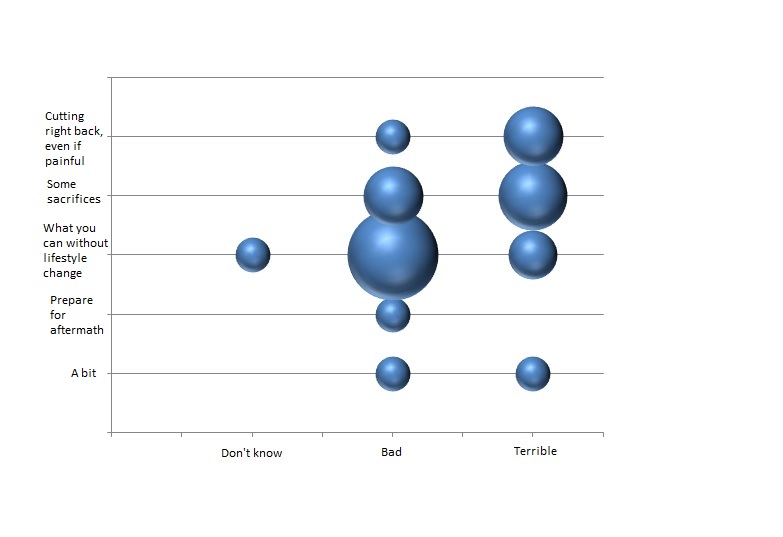
The survey indicated that once you are over your denial of climate science, the amount of change you are willing to make to reduce your impact is correlated with how bad you think the outcomes will be.  Phew, that is a wild conclusion given the survey was unscientific, small and biased.  But it makes logical sense, so I’m running with it.

So, less contrary and inaccurate bilge in the press, less for people to hang their denial hats on, more chance of progress.  I’m not sure the logic follows either.

But, we’re going for it anyway, for the last time maybe.

The experiment this time is whether a clearly inaccurate statement gets retracted.

Thank you to Graham, who has both pointed out the article and done the research.  The target is an article in the Express in the UK by Leo KcKinstry, with the headline “Global warming is about hotter, drier weather … not flooding“.

There is an awful lot that is wrong about the article, but we decided to go for the two most obviously inaccurate statements.  The following is the first email to the Express:

Dear Sir/Madam
 
I would like please to draw your attention to two inaccuracies in the recent article “Global warming is about hotter, drier weather … not flooding” by Leo McInstry in the Express on 13 Feb.
 
I hope you will publish a correction?
 
Firstly, the headline is inaccurate.  Global warming is about flooding.  Please see the following extract from the IPCC report:
“Changes in many extreme climate events have been observed since about 1950. It is very likely that the number of cold days and nights has decreased and the number of warm days and nights has increased on the global scale. It is likely that the frequency of heat waves has increased in large parts of Europe, Asia and Australia. There are likely more land regions where the number of heavy precipitation events has increased than where it has decreased. The frequency or intensity of heavy precipitation events has likely increased in North America and Europe. In other continents, confidence in changes in heavy precipitationevents is at most medium.”
 
Secondly, the article states “In fact in the last century in Britain there were four winters with heavier rainfall”.  This is not true.

The UK has had the wettest winter (517.6mm of rain fall) since national records began in 1910, the Met Office has confirmed.

John, Graham

So, climate change is real – what next?

Danny Bonnett and I are meeting David Gauke, the UK minister for tax, on Friday.  In the context of recent affirmations on the reality of climate change from the leadership of the Conservative party, we will discuss with him the policy implications, particularly for shale gas or fracking.  The following is what we intend to say:

David Cameron and George Osbourne have recently stated that climate change is man-made and that we should do what we can to prevent it.  We are faced with a choice between either leaving shale gas in the ground or with missing international pledges to limit temperature increases to 2° Celsius.  What will the government choose?

David Cameron, UK Prime Minister “I believe man-made climate change is one of the most serious threats that this country and this world faces”.

“I’m someone who believes climate change is happening, that it’s caused by human beings. We should do what we can to prevent it” George Osbourne, UK Chancellor of the Exchequer.

According to the science, current climate change targets in the EU would lead to a 30-50% chance of keeping temperature rises below 2° Celsius.

To me, “doing what we can to prevent it” does not equate to aiming for a 40% chance of success.

Put simply, if we are to back up these words and commitments with action, shale gas production cannot happen in the UK, even with carbon capture and storage.  At the point when shale gas production in the UK would be becoming large scale, we would have to stop, leaving wells only partly tapped.  Investment in shale gas would also delay investment in very low or zero carbon sources, leaving a huge legacy for future generations.

Achim Steiner, head of UN Environmental Programme “We sometimes have to take a step back and ask ourselves: for the sake of having another 20 years of dirt cheap energy are we really going to put millions of years of evolution, of ecosystems, of ecosystem services at risk?”.

I agree with George Osbourne when he states “Let’s try and do this in as cheap a possible way as we can”.  The cheapest way to tackle climate change is to invest now in zero or very low carbon energy.  The sooner we make this move, the lower the overall costs, as Lord Stern described in his report in 2007.  If we want to continue to revitalise the economy, let’s do it in a way that creates skills and jobs that are relevant for the future.

John Bell,

Ordinary bloke

Update on all things Bell

Here goes, for an update on everything climaty (climatey?) going on in my life.

Let’s start from the inside as ever, in true permaculture style.  I have been working on my self-control and freewill.  I’m able to avoid too many biscuits, although the tin does go down too quickly, and haven’t allowed myself to fall into the trap of too much coffee or alcohol. Mrs Bell was away last week during half-term, and a bottle of wine stayed unopened on the sideboard.  Well done me.

I’m going to use nicknames for the kids from now on in the blog, so they will be Tall, Small and Bubs.  Bubs has just got over a bout of chicken pox, which we’re expecting to pass over to Small in the next few days.  I’ve been walking around London with a very muddy jacket after a kick-about with the kids and a few new friends from nearby Tring – I was in goal but only using my head.

I’ve been excessively busy with my business, but still have managed to find the odd day here and there to keep the climate related projects on the move.  The allotment is pleading for my attention, though, with the compost heap sprouting weeds and nothing being sown so far this year.

In Berkhamsted, organisation for the B-Hive public meeting continues apace.  We have sent out invitations to all of those organisations, groups and businesses we have identified as stakeholders in the town, as well as those on the mailing list.  The public meeting will give us a chance to let the people of the town know what happened as a result of the town consultation we organised last year, and for them to influence what happens next.  Interestingly, a survey run by one of the town councillors (and founder of Transition Town Berkhamsted) on the subject of a proposed multi-story car-park (please, no) showed than no matter what our opinion on car parking we all seem to want a more holistic plan for the town – something like 97% of us.

The opportunities seem to be opening up for a community energy scheme in the town as well, with Seb Beloe starting up a team looking into prospects building on the successes down the road in King’s Langley.  Couple that with some possible interest from a local secondary school and we may be looking at lift-off.

Which will tie in well with the upcoming Transition Beds, Bucks, Herts conference on 23 March.  We’ll be meeting up to talk about how to scale up the movement, while avoiding burn-out and taking time to celebrate.

Further out still, the Power Shift UK conference is getting close to having a date and venue in April.  If you get emails from 350.org, you may have seen something about it.

John Bell,

Ordinary bloke

How to help someone get over denial

Coping with loss is traumatic.  Within our brains, bereavement is the identical to coming to terms with an addiction.  Or to any unwanted change.  Like the reality of climate change.  I am writing down here my thoughts on how to help someone accept the reality of climate change, so they can get over their denial and move on.

This is important, as while someone is in denial they will continue their destructive behaviour.  When they are over it, which will be a traumatic experience, they can then start to make positive plans.

I draw on an article on how to help a loved one come to terms with a loss or addiction.  The lessons come from helping someone with depression or other mental illness or a drinking problem.  They are equally valid for climate change denial.

I invite you to think of someone you know who is currently in denial about climate change, and then read on.

The article starts by emphasising that everyone is different.  It may be that the person you have in your mind hasn’t really thought about climate change, they just read the Daily Mail.  Or it may be that they have thought long and hard about it and have convinced themselves there isn’t a problem.  The depth of the denial, and the potential for conflict, will be different in both cases.

First off, the article recommends gathering information.  On the one hand, you need to be sure of your own ground about climate change and the denial arguments.  On the other, you need to observe your loved one to understand where they are with climate change.  You might want to ask them some non-leading questions, such as what they read.  Give yourself time to gather this information; there is no sense in rushing.

Then make a plan.  Are you going to gather a few friends round and confront them?  Or bring things up casually over a few conversations?  It will depend on the information you have gathered, the person and your relationship with them.

When the conversation or confrontation is underway, the article recommends stating the facts.  I’m not thinking facts about climate change, necessarily – more facts about the person and their denial.  Importantly, they need to be facts that cannot be denied.  Such as them getting angry whenever climate change is mentioned, or that they only read right-wing papers.Dismissive

During the conversation, the article recommends that we are sincere and have sensible expectations.  “If the intention of our confrontation is to make our friend get help for her disorder, we may very well come away shattered. However, if we voice our concern simply as an act of love, we will be at peace knowing we have spoken the truth and tried, even if she continues to deny the problem.”

Say “I” at the start of the sentences, which changes your mindset and theirs.  Rather than “you just can’t accept the truth, and it’s damaging the environment”, you might say “I feel sad when I see you leave the car running”.

Asking questions, and giving time for the answers, is recommended.  “Do you think you might be in denial about climate change?”

Have some resources ready for them to take away and read, such as links to information about denial or climate change.

And make sure you allow them the chance to talk to you again when they are ready.

Finally, it is important to protect yourself.  Set boundaries, such as being unwilling to argue about wind turbines yet again.  And recognise that helping someone come to terms with climate change is a long and draining task – make sure you are replenished with friendship and advice from others.

If you want to think about this conversation further, you do a lot worse than watch this video from George Marshall.

John Bell,

Ordinary bloke

Bike

Regular readers will know that I was thinking of getting a bike a while back.  Astute regular readers will know I got one (from Lovello‘s in Berkhamsted).  I did do a tiny amount riding when I was a kid, and I’ve even been on a mountain biking break once.  Nevertheless, I was nervous about coming a cropper on the roads, and am still learning.

For those who want to know, the bike is a hybrid, which means it is not an out and out road bike, but does work away from the tarmac as well.  Good job too, given the state of the roads around Berkhamsted, where potholes are a continual problem.  I’m using it on the roads mostly, although I expect to cycle to nearby Tring or Hemel Hemstead on canal tow-paths at some point.

My bike

My bike

Before I got this bike, I’d picked up a series of second hand rusty contraptions from eBay or friends for £20 a time.  I was under the impression that I was terribly unfit and not built for riding a bike up a hill, and so gave up.  With the new bike, full tires and a few gears, suddenly I can now whiz from the station at the bottom of the hill in Berkhamsted to my home at the top near the woods in no time.

I’m still nervous on the bike, though.  I find myself tensely holding on and hovering over the seat.  When I notice, I tell myself to relax and sit down, otherwise my balance is a little edgy.  I’ve already fallen off once, skidding round a corner in the wet going to fast.  Thankfully the only involvement of a car was a nearby driver asking if I was alright.  Of course I was, I said.  Took me a couple of weeks to recover from the painfully swollen wrist, but I didn’t let the driver know that.

The bike is definitely a better mode of transport than car for one person to make short journeys around town.  It’s quicker and gets you moving, and you don’t have parking problems.  And of course it’s zero carbon.

It’s not as clear-cut for longer journeys or those where you need to carry a load, such as shopping or the family.  There are those that commute between towns with pedal power and cart their food and children around in contraptions on the back, and those people do tend to be very fit and healthy.  I do see myself doing that sort of thing at some point, but I’ll need to feel a bit more confident and a bit more fit beforehand.

Using a bike rather than car for short journeys is very logical and sensible.  I would hesitate to say that the reason not more of us do so is because of fear and that intangible comfort barrier.  That’s what stopped me.  I can now honestly say that my life is better for taking the plunge, as I have more time and am getting fitter.

What’s stopping you?

John Bell,

Ordinary bloke

Rationality and climate change? Surely not.

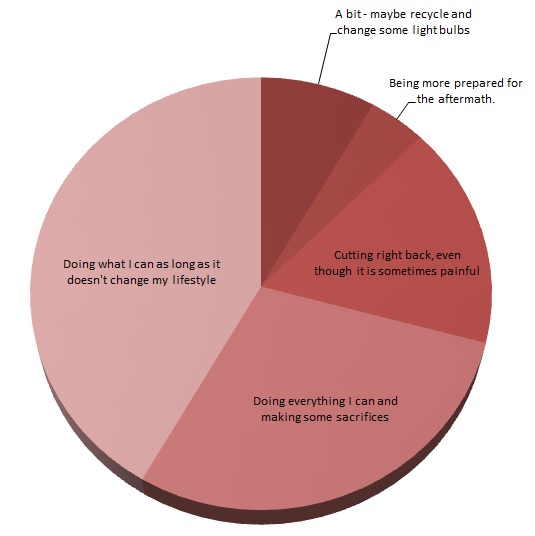
Are you more rational than the next person?  I tend to think that climate change brings out the madness in people, but you lot seem rational.  The results of the survey show that the worse you think climate change is, the more you tend to actually do something about it.
Team JB Survey - My Response
That does make sense.  It’s while coming to terms with the existence of man-made climate change that people behave irrationally, going through the denial phase of accepting a change.  Once you have got over the denial phase, you are adapting to your new acceptance of the way the world works in a much more positive and forward-thinking manner.
Team JB Survey - My Response vs Scale So getting the 50% of Westerners over the hump, through the emotional barrier and into acceptance of man-made climate change could be key if we are to avoid disaster.  It doesn’t even need to be all of them, just the top few percent of emitters.  That’s those that fly once or more a year or earn £30K or more.

John Bell,

Ordinary bloke

“Climate change” flooding out

After years of avoiding the subject, our illustrious political leaders are now starting to talk about climate change.  Here are their recent quotes, in light of the incessant floods in the UK:

David Cameron (Prime Minister, Conservatives): “Colleagues across the House can argue about whether that is linked to climate change or not. I very much suspect that it is”

“We can’t attribute any one event to climate change, but we know climate change is going to mean we have more events like this – more extreme weather events, more flooding, more storms.  If there’s one thing we know about the effects of extreme weather, it’s that the costs – financial, human and other costs – of not acting are much greater than the costs of acting. It’s a totally false economy to say ‘Don’t act’. The Government’s got to realise this and it’s got to take the problem seriously.” Ed Milliband (Leader of the Opposition, Labour)

Nick Clegg (Deputy Prime Minister, Liberal Democrats) – on the prospect of leaving Europe “We will not have the clout to lead in Europe and the world in the fight against climate change as we do right now”

“David Cameron hasn’t committed to serious, sustained action on climate change, which the Met Office tells us all the evidence points to as contributing to these extraordinary floods. It isn’t too late for the sadly laughably self-titled ‘greenest government ever’ to start to live up to its name Natalie Bennett (Leader, Green Party)

Nigel Farage (Leader, UKIP) dismissed climate change as the cause of the Somerset floods and said it was “just the weather”.

The most famous quote from recent days from this bunch was David Cameron saying the “money is no object” in dealing with the floods.  Of course, he meant in conjunction with the immediate relief effort, but he wasn’t specific, and left himself open to questions as to whether he meant longer term measures for flood defences.

It would be cheaper long-term to reduce our carbon emissions rather than spend billions on making the country more resilient.  Unfortunately, it’s probably too late for that.

John Bell

Ordinary Bloke

My name is John, and I’m a denier

Everyone is. You are. I think this is really important.

I am in denial about the inevitability of climate change disaster. The good news is that realising I am in denial might just allow me to come to terms with the apocalypse and find my way through.

It seems that the natural human way to deal with any change, not just a bereavement, is roughly the same. Firstly, there is brief shock, then denial. Ignore the facts, and we cope. As we accept the facts, we move through anger, bargaining and inevitably depression. Only when after dealing with those emotions can we move on to acceptance and positively learning our way beyond. We can stay in any of those phases for long periods, and can yo-yo between them.Phases of accepting change

I went through these stages with climate change, just as I am going through them again with our ability to avoid its worst effects. With climate change, for years I was aware of the problem, but avoided thinking about it. Then I remember watching the climate change denial documentary “The Great Climate Change Swindle” and grasping on to every word with hope. It was of course gibberish, but I wanted to believe. I’ve written about the anger I have felt. My experience now makes sense, with an understanding of the stages of accepting change.

I am ever hopeful that we will avoid catastrophic climate change, but I now accept the need to prepare for the worst. We have put a defibrillator to the beating heart of the planet, and are fiddling around trying to reduce the current rather than taking the paddles off. Emissions are increasing, targets are being watered down, and there is no sign of us making the connection between the destruction of the planetary life systems and our own wanton consumption.

When it comes down to it, I’m denying to myself is that there is a half-decent future out there for us, even if we are laggardly in lowering our carbon dioxide emissions. I am reluctant for some reason to think through what that future would mean. I have a painful vision of defending my family homestead from hungry marauders, like a scene from 28 Days Later. Maybe a better version would be the world working together to survive, long enough for us to stabilise the climate once more over a few hundred years? We’d unlikely be able to do it more quickly than that – there are 7 billion of us spending every waking moment burning as much fossil fuel as we can, what hope of doing the same in reverse?28-Weeks-Later-28-weeks-later-26663151-1499-996

So, what next? I’ll have to get depressed for a bit, I suppose. Then I can get on with designing my future in a Cretaceous world.

John Bell

Ordinary Bloke

PS – does that mean that in the meantime I can happily stop worrying about reducing my own carbon emissions? Can I fly again? Oh, no. That would be immoral. Climate change kills, and will kill. Contributing to it makes me as guilty of manslaughter as a parent smoking in the family home or car.

“Perhaps we should learn to expect the extreme”

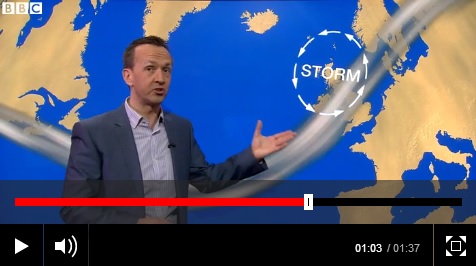
So said BBC weather presenter Nick Miller as he explained the cause of the high winds and incessant flooding rain we have experienced in the UK this winter.  It is the closest anyone gets to saying “climate change”.

BBC Nick MillerWhether the weather we are witnessing is caused by global warming or not, it does give us the chance to experience the kind of climate the scientists forecast to be around in the future.

I think the stranded people of Somerset, washed away railway lines, battering winds and disappearing coastline are almost certainly caused by man-made climate change. As explained by Nick Miller, the storms are a result of a faster jet stream, born from the extreme cold over the US. In turn, the temperatures beyond freezing in the states are caused by the polar vortex burrowing its way southwards far beyond its normal reach. This is a result of a combination of the jet stream being weaker a few weeks ago and bubbles of warmer arctic air shifting blobs of the polar air around. Warmer arctic air is directly a result of climate change, and the weaker jet stream was a result of a lower difference in temperature between the equator and the north pole.

But you aren’t hearing that in the media. Everyone is scared of the in-built gut reaction they’ll receive back in torrents with a sniff of a reference to climate change.

Missing railwayWhat we are seeing now is just the start. This is supposed to be the good bit where we get longer growing seasons and milder winters. How bad can it get when our children are our age? I don’t want to find out, and I don’t want my kids to find out.

This should be the latest in a long line of wake up calls that spur government, business, you and me into action. There is an awful lot to do. And we are not doing it.

If you want to help me, get in touch.

John Bell

Ordinary Bloke, or just plain John Bell