Determined to make a difference

You may remember me talking about a conference for local Transition Towns.  It’s taken me a while to write up what happened.  I got the perfect shove up the proverbial when none other the Rob Hopkins, the founder of the global Transition movement, got in touch to ask me to write about the conference.  The below is what I have come up with so far – it is a sneak preview, and will probably change with comments and editing before it is published anywhere else:

I’m very proud to say that on 24 March we held the first Transition Beds, Bucks, Herts conference.  Wow, sounds good.  A dozen local Transition Towns came together to celebrate our successes, inspire the next project and see how the sum of the parts can be greater than the whole.  It was surprisingly easy to organise, and has certainly inspired me to get going with a Transition Streets initiative in Berkhamsted.

We had a previous gathering in October last year, and the idea for the conference emerged.  Organising was simple – the door was open, it just needed a gentle shove.  For the initial gathering last year, all that was needed was to choose a date, book the venue and then send an email to a few addresses found on the web or in my address book, and word spread.  I asked for a small contribution to cover costs and for people to bring food to share, and the job was done.

The conference itself took slightly more organising, as it was open for anyone to attend, so we put together a booking system as well, and organised an agenda.  We used a survey to find out the level of interest and what people wanted to talk about.  I have to thank John Ingleby of Transition in Kings for his efforts in finalising the day.

Abbots in Transition, Change4Chalfont, Haddenham in Transition, Hemel in Transition,Low Carbon Chilterns, Transition in Kings, Transition St Albans, Transition Town Letchworth, Tring in Transition, Winslow Transition and Milton Keynes attended, although Abbots and Winslow were unable to come along this March.

We organised it a bit like Open Space, with pre-defined topics.  We all split up in the morning to talk about community energy, food security and Transition Streets.  I went to the latter, and listened to the great work from St Albans and how that could be combined with Street Play to get people out of their boxes and build that sense of community.  There are now Transition Streets starting up in Tring, Abbots Langley and by me in Berkhamsted.

There was a similar success story with community energy, with Grand Union Community Energy (GUCE, pronounced Juice) of Kings Langley inspiring Letchworth, Berkhamsted (GUCE-B) and Tring (TRICE).  John Ingleby led the workshop, based on the experience of GUCE in raising £72,000 to install solar panels at a local school during 2013.

The project involved a steep learning curve, and GUCE were awarded some additional funds by the Herts and Dacorum councils, which they used to document all the steps they took in the form of an online “Toolkit” rather like an Advent Calendar, where you should only “open” a box after all the preceding steps have been tackled.

We then enjoyed our food and each other’s company, before moving into the afternoon.  The plan had been to split up to talk about personal resilience (aka avoiding burn-out); scaling up the movement; and energy measuring gadgets.  As it turned out, almost everyone wanted to scale up the movement, but felt too time-pressured and exhausted by the prospect, so there was a general decision to hold a plenary on personal resilience followed by the same on scaling up.

I have to say that I think this was a mistake in hindsight, as there were a small number of people who hadn’t the slightest interest in either topic and wanted to see the thermal imaging camera.  I don’t think we had enough time to devote to what really needed to be a more intimate discussion on the stresses and strains of this work.

I think the afternoon was actually a microcosm of the whole movement as I experience it.  We all feel that there is so much to so, and we feel as though we need to do it all, rather than taking our time and doing one thing right.  So my learning from the afternoon was just that – don’t try to take on more than you can cope with, and do a loving, beautiful job on what you do commit to.

Then we moved on to Scaling Up, and a few peeled off to have a look at the camera.  John Ingleby spoke about his experience of campaigning with The Hunger Project (HP) in the 1980s, when people were invited to “sign a card to end world hunger”. In 1984, HP volunteers achieved 58,000 cards signed in three months – 0.1% of UK population at that time. Participation in HP increased substantially through these campaigns. While not suggesting Transition should turn to signing cards, there are several valuable lessons for scaling up:

1.    A clear message

2.    A defined end date

3.    Frequent publicised progress reports

Campaigns with these features are almost always successful (for example, community energy share offers). As when a large group of people light candles from each other in a darkened room, the time to light the last 100 can be less than it takes the first two.

John proposed we should promote the goal of “Zero Carbon by 2030”, and the following discussion explored how this may (or may not) be appropriate for Transition.

Over the two events we have made between us a host of very important connections, between each other, ideas and learning insights.  Christine Hopkins said of the event “Great to be in a roomful of people determined to make a difference, and not just in a small way! Getting together with people from around our region, exchanging ideas and spreading the network, is inspiring and motivating.”

Here’s to the next one, when it is the right time.

John Bell

Ordinary Bloke

Conservative moratorium of onshore wind

I sent this to my MP. If you have a Conservative MP, I implore you to write to them on the same topic. My email was sent before the recent UN report that says that the current actions on climate change are only sufficient to keep temperature increases to about 4 degrees Celcius. They suggest we start now to make a speedy transition to renewables from fossil fuels, with natural gas replacing oil and coal for the next 20-30 years.

My email and David Gauke MP’s response are below:

Dear Mr Bell,
Many thanks for your email. I have made David aware of your concerns.
Kind regards,
Polly London
Office of David Gauke MP

From: John Bell <jubble@hotmail.co.uk>
To: David Gauke MP (home) <david.gauke@btinternet.com>; David Gauke MP <david@davidgauke.com>
Sent: Thursday, 10 April 2014, 14:39
Subject: Onshore wind farms

Dear David
Thank you for your time at the recent surgery in Berkhamsted.  I have to say I was bitterly disappointed when it came to the budget itself, with so many reductions to the renewable energy sector and the freezing of the carbon floor.
The future of the energy sector remains strongly in the low-carbon energy sector, which is largely renewable energy.  Shale gas is not low carbon, it is high carbon.
I have read that there is consideration to include a moratorium on onshore wind in the Conservative manifesto for the next election.  I sincerely hope that this is not the case, and urge you please to make your voice heard in opposition to any such move.  It would be very anti-market forces, and drive the UK to miss out on a fantastic opportunity to lead the way globally in this vital technology, which would supply jobs and low-cost energy for decades to come.  Onshore wind is by far the cheapest form of renewable energy out there, and is becoming competitive with fossil fuels – that is why Ecotricity have been able to freeze their electricity prices for 21 months, and expect to reduce prices going forward.
If the Conservative Party is willing to try to persuade the public on the use of unpopular shale gas, surely it can do the same for onshore wind.
I was pleased to hear that 70 global corporations, including Unilever, Shell, BT and EDF Energy, have called for governments to step up efforts to curb greenhouse gas emissions.  I hope the Conservative Party will take note.
John Bell,
Ordinary Bloke

Get a Shift on

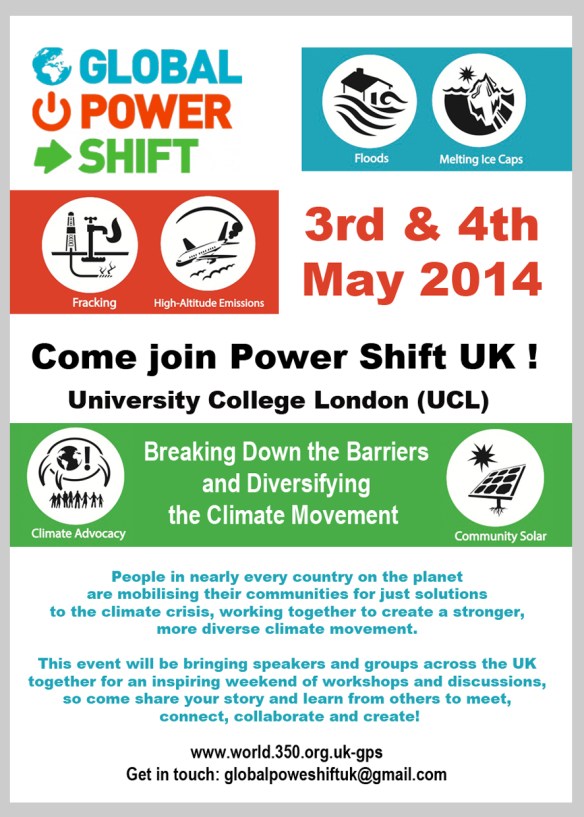
It’s very gratifying to see Power Shift UK taking shape.  Months of discussion and work are finally paying off.  It’s all been from an ever changing team of volunteers, spending their spare time moving the Shift forward (or shifting the movement forward, possibly).

For me, it started before I left my job to help the climate effort in February last year.  I unsuccessfully applied to join the Global Power Shift in Istanbul.  Thankfully that wasn’t the end of the road, as I bumped into Nico Wojewoda of 350.org at a rally against the Keystone XL pipeline.  That got me on to the UK team.Tour

Skype has been our friend, and we’ve made good use of shared documents and email to help new people get on board as quickly as they might.  There have been highs where the team looked unstoppable, such the London Fossil Free tour.  I was brought to tears at a flash mob, singing about the melting arctic.  And there have been lows when the team withered away and was reduced to one or two.

The direction of the Power Shift in the UK took a while to emerge, and I’m glad that it did. Susan, Claire, KMT, Tara, Ben, Phoebe, Asad, Tom, Suzanne and David – the team that did go to Istanbul – lead the way to the theme of increasing the diversity of the climate movement.  The UK is already doing very well, thank you very much, with many groups dealing with fracking, fossil fuel divestment, local food solutions and the like. What is missing a platform which links it all together so that connections are strengthened across all socio-economic and ethnic backgrounds – this is the aim of Power Shift UK; to connect us in a movement, together.

This theme and the idea of the Power Shift UK conference that is now happening on the 3rd and 4th May was fleshed out one blustery weekend at the May Project Gardens in Morden in south London.  The team at the time was KMT, Jenny, Tom, Susan, Ben, Claire, Izzy, Tara, David and myself.  Bernadette facilitated as the plans for the conference were put down on paper.  Amanda, Suzanne and Louise have all played their part.

It wasn’t until much later that the date and venue were set in stone, as team commitment and energy went through a lull, which was finally ended with the addition of the marvellous Emily, who was able to dedicate some meaningful time to the task in hand.  She then brought in the Campaign against Climate Change, and in particular the fantastic Fiona, and now we have the remarkable Lindsay as well.  This is the group, with the help of Claire, Susan and myself, who are bringing the plans into fruition.

It was great to hear at the recent gathering of the Climate Coalition (formerly Stop Climate Chaos Coalition) just how well our plans fit into the wider UK climate movement.  We’re on the right track.  The Power Shift will help lead through to the “For the love campaign” and an escalating series of events leading towards the crucial talks in Paris next year, where the governments around the world will put pen to paper with a deal on climate change.  We’re going to make sure that deal is up to the task, while building the solution from the bottom up should the politicians fail.

It all starts on 3/4 May – come and be part of history.

John Bell

Ordinary Bloke

My part in the UK climate movement

Over the past year or so, I have met with a number of the leading lights in the UK grassroots climate movement.  We’re all part of it, we just don’t always know that we are or realise that there is a movement at all.  The Power Shift UK is aimed at bringing us all together, as part of wider strategies from other UK and international climate change organisations.

I see the movement as providing so much that it is hard not to agree that it is a hugely positive influence on life in the UK.  Thousands of groups and people around the country are working in their own way to bring community back into their neighbourhoods, where at the moment we are getting used to an insulated lifestyle that revolves around a digital display.  They are finding ways to generate electricity from the sources of energy provided to us by nature.  They are finding ways to reduce our outgoings so we can have a better standard of living.  They are preserving their local natural habitats from an increasing human population and its consequent demands on our natural world.

I am not alone in finding the work a huge drain on my time and energy, as I spend countless evening and days away from the family in meetings.  It can and does feel depressing and feed exhaustion in the face of seemingly overwhelming apathy, wilful ignorance and destructive behaviour from what seems like the majority.  The political class follow what they feel is the vote-winning majority view, and fail to see the opportunities of a change in direction or the dire consequences of our current path.

That is why I am part of Power Shift UK (3/4 May – book your place now, it’s free, and we might even pay to get you there) which is working with the Campaign against Climate Change (CCC) to unite the UK climate movement at all levels.  The strategy aligns with that of the other UK climate organisations, represented by the Climate Coalition.  It is Power Shift “UK” because there are Power Shifts happening all over the planet, from the places most affected by climate change in Africa and the island nations, to the lead culprits in Australia, the US and Canada.

Power Shift UK - 3/4 MayI have been working with Fiona and Laeti at CCC on a funding application to help support the work.  This is where we are at in describing our aims:

  • To provide concerned citizens and groups with a platform for discussion and learning around climate change issues; to build a strong foundation and diversified movement to ensure a just transition towards climate justice and action
  • To give communities and their projects the spotlight and opportunities to demonstrate that alternatives and solutions to climate change are possible; To learn from these community solutions; To invite communities to share their skills in and outside the climate movement.
  • To influence policy and key decision makers in the UK in order to provide a mandate for them to implement the example solutions and alternatives put forward by our British communities; To create space for change to protect citizens who already suffer the consequences of climate change in the UK.

Knowing we are part of a much bigger movement breeds togetherness and a positive, re-enforcing energy that helps to conquer the exhaustion.  It brings inspiration, ideas, skills and experience that strengthen what we do.  It allows people who are partially involved, or are merely at the moment observers, to give themselves permission to join the movement, be that making changes in their own lives, taking part in an event or helping with an initiative.

This groundswell will give the politicians the mandate to enact legislation and bring in policies to turn the tide and bring the rest of us along.  Critical mass will be reached and apathy and ignorance will be swept up in the river of change and what might at the moment seem like inconsequent activity will be justified.  It is that vision that keeps me going.

Will it happen?  I can only hope.

Global power shift flyer 2

John Bell

Ordinary Bloke

For the love

I love walking with friends and family, or on my own, in the summer, winter, autumn and the spring.  I love a good book.  I love eating.  I love my wife.  I love my children.  For the love of all that I care for, we must get to grips with climate change.

You’re now supposed to be ripe and ready to have a conversation about what it means to tackle climate change.  The “For the love of…” campaign of the Climate Coalition has been carefully designed and researched to have the maximum impact on those people who are ready to talk about climate change.

The research was carried out by COIN (Climate Outreach and Information Network), who ran workshops with a range of people to understand what messages worked, and what fell flat.  Not surprisingly, they found that people find most existing rhetoric on climate change disenfranchising, over-presumptive and preachy.  Pictures of polar bears and discussions of the “most serious threat we face” are a turn-off.  Certainly explains why it’s only really the “converted” that read my blog.

The one message that did gain traction was in tapping into people’s emotions and asking them what they love.  Almost certainly, whatever that is will be under threat by climate change.  You can then say something like “For the love of chocolate, we must do something about climate change”.  And so the conversation starts and is remembered.

This only works for people when the example is something real and precise, rather than abstract.  “For the love of the future” wouldn’t cut it.  It seems that the more emotional the connection and the unexpected the example the better. “For the love of a decent pitch” might work.  Above all, the message will be respected if it is seen as being said with integrity.

Next Monday I’ll be going to a meeting with the Climate Coalition to discuss the launch of this campaign, with 80 other representatives of the 100 or so organisations that form the coalition, representing their millions of supporters.  I’ll let you know how it goes.

There were a couple of other interesting insights in the COIN research.  One was that conservatives and community-minded optimists (like me) alike identified avoiding waste as a core value.  I wonder if the information that we dump 40kg of carbon dioxide in the atmosphere for every 1kg of waste we put in landfill would bring a few more people along?

The other titbit of information in the COIN research was that a lot of people involved thought that examples of real people doing real things to solve the climate change problem would be persuasive.  Diverse voices work.  I’m glad to hear it, as that is the focus of the Power Shift UK conference in London on 3/4 May.

John Bell

Ordinary Bloke

The significance of Transition

May 2014 will mark the second anniversary of my first being elected Leader of Transition Town Berkhamsted.  It was and is a huge honour to be chosen for the post.  If I am elected again this year, it will be my final year in the post, as I have said that three years is the longest anyone should be Leader.  With that in mind, I want to ensure that the organisation is in as good a shape as I can before I make way for the next person, and so there are some conditions to my accepting any nomination this time around.

I believe that the work of Transition Towns over the planet is vital.

Not only does it allow us to break away from the malaise or frustration brought on from watching politicians convening to fritter away our future: it also means taking the necessary steps at home and in our towns to address the issues of climate change, resource depletion and inequality.

On a more pessimistic note, it means preparing for and safe-guarding against the potential collapse in society and our wellbeing that could result from these global issues, as we build local energy and food sources.

But the challenge is huge.  The number of people actively taking steps towards a positive future is small compared with the number who are carrying on, hedonistically but unknowingly doing everything they can to hasten the worst outcomes.

Over the past two years we have achieved an awful lot, with huge and important contributions from a number of different people.  With first the Positive Money talk with Fran Boait, and then the Ashlyns Lectures, we have established a method of putting on talks and attracting internationally renowned speakers that has allowed us to fund other activity.  The B-Hive has led to us raising our profile in the town, talking individually to over a thousand different people and garnering close links with local government and other groups, organisations and businesses.  There have been some gigantic steps on transport as well, from the edges of Transition, with the Safer Routes to Schools work.

This all feeds into our strategy of building community, linking groups in the town and pushing towards a widely adopted town plan that contains sustainability and resilience at its heart.

But, if we are to have any meaningful impact, we need to scale up towards critical mass.  The only way we can be successful is if we work together as a strong team, community and group of friends.  And that doesn’t mean one Leader upon which everyone can rely.

So, if I am to be Leader for 2014/15, I’m listing here what will need to be in place for me to accept any nomination.  Please discuss amongst yourselves to make sure it is all covered – you have under 8 weeks until the AGM (on 15 May).  Otherwise, I would be happy if someone else would like to put themselves forward as Leader.  Failing that, we will see how the organisation functions without a Leader in post.

On its own, this won’t be anywhere near enough to make the seismic changes we need.  But it is the minimum.

What I need:

  •          The Leader position will be renamed Chair, or some other piece of furniture that doesn’t imply being sat on comfortably.  It needs to be a consensus team effort and Leader goes against that in my view.
  •          At least one person needs to say that they would be happy to be Chair from May 2016, barring changes in circumstances.  This will allow us to transition.
  •          We need to share out the jobs.  That means the following roles need to be filled, with committed, enthusiastic people.  Details of the roles are available by following the links.  Most of this is covered at the moment already, but there are some gaps.  Above all, common sense will need to be applied.

o   Membership (currently Claire Mistry), Website / Facebook Administrator (currently shared between Marion Baker and Claire Mistry), Newsletter / Digest (new), Communications / Forum (new), Finance & Funding (currently Emma Norrington), Publicity (currently Bex Plenderleith), Ashlyns Lectures Co-ordinator (new) and Planning Socials / Inner Transition (new) plus points of contact for Energy, Food and Transport.

It might be preferable that a group of people pick up each role, so don’t be put off by one aspect.  Having said that, one person could do an entire role, or one person could even do more than one of them.  We can of course discuss if you would like to change anything – just get in touch.

I don’t intend on bashing people over the head with the role descriptions: I’m just looking to share the leadership responsibilities.  I do reserve the right to have what might become known as the “dreaded quiet word” now and again, though.

  •          We need to show that we are a buoyant organisation with dedicated members.  8 people need to commit to putting the dates of the Green Drinks in their diaries for the year of June 2014 to May 2015, and to prioritise holding the date, barring disaster.
  •          The Forum concept is the right one for communication, as it allows inclusivity; being selective as to what you read; and for structured conversation.  10 people need to commit to using the forum for all communication on Transition Town Berkhamsted, other than confidential discussion, but including information relating to activity tangentially related to TTB.  Note that the Communications role includes training people on the use of the forum and improving its usability.  Please reply to this topic on the forum if you are happy to be one of those 10 people.

I’ve added a new page to my website to keep track of these criteria being met.  I will not be chasing around to make sure that they are – that is up to you.

John Bell

Ordinary Bloke


The World as I would like to see it

In my last post, I said that Transition was moving to a more insular society.  I was wrong.  Transition is moving towards a society where communities are more self-reliant, that is true.  But not insular.  The realisation has lead me to muse about what the world would look like if Transition succeeded, at least my interpretation of it.  Read on MacDuff, and let me know what the world would look like if you had your way.

I’m dumping my brain here, so there are bound to be flaws.  I would welcome your feedback and recommendations to reading material.

The Transition movement and the like are often characterised by visions of sandal-wearing tree-huggers who would rather see everyone living in tepees than cosy indoors.  There is a grain of truth in that.  But it is very much a caricature to which most involved in Transition Towns would not aspire.

The world I would like to see remains connected, where the easy life is the norm.  It is possibly more inter-connected than we are now, but with less travel.  World society would be characterised by helpfulness between people around the globe and with nature rather than competition and exploitation.  There would inevitably be some people with more means than others, but all would help the needy in times of distress, such as when crops fail, disease or illness strikes.

Yes, communities would be more self-reliant for food, warmth and medicine.  There would also be a global sharing culture of ideas and expertise to improve everyone’s lives, rather than competing in the “Global Race”.

So, how would this be co-ordinated?  How would it be governed?  The way I see it, central governance is only needed to manage those activities and resources that are simply not possible at a community level.  We need more of that at the moment because our society is fine-tuned to live at the edges of our capabilities.  The population is as big as it can be for the amount of energy we can create and the food we can grow or rear.  We are utterly reliant on economies of scale to support the global population.  So, while we are building up the capability, skills, will and technology at the local level to support ourselves, we need government to provide that which we are unable.

At the moment, that central supply of services is not provided by government alone, it is provided by corporations as well, possibly to a larger extent.

But, once we have the ability to support ourselves locally, and with the connectedness of the internet to share ideas and ask for help, central governance from whatever angle would be less necessary.

I fully realise that is a bit of an idealised picture.  What if the internet broke down? What lazy good-for-nothings, leaching of the rest of us?  What if a group or person got ambitious and decided ethnic cleansing would be a good idea?

My vision does rely on us having adopted practices of food and energy production that require little effort to maintain, either through new technologies or through working with and alongside nature rather than against, such as edible forests or the farming practices described in the sample chapter of “An Optimists Tour of the Future”.

That would mean less time needed for the basics and the social constructs such as financial markets, and more for a flourishing culture, for art and innovation.  It would also allow us to turn to supporting others in times of need when evil set in and to maintain the internet.

So, where does that leave you?  Like it, loathe it, see the obvious flaws?

(A strange thing just happened.  Just after I wrote this piece I read the follow-up to the article I cited in my last post.  It reads as a more in-depth version of my own post, uncannily similar).

John Bell

Ordinary Bloke


The Wrong Direction

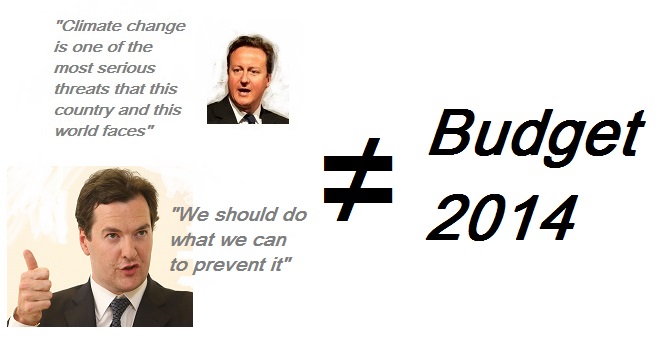
Not Equal Do What We Can

Exemptions from carbon tax for the worst polluters, freezing the UK Carbon Price Floor at £18 per ton until 2020 when the UN says £60 is needed.  The message this sends out is that the UK government is not committed to addressing climate change.

I’m afraid that might be true.

John Bell,

Ordinary Bloke

So, you think I’m a bit mad?

I suspect you think I’m being melodramatic when I talk about society collapsing.  It might seem a tinsy bit far-fetched. I also think that the worse you think climate change is, the more they are likely to try to do something about it.  So I’m bringing in NASA to help outline my case.
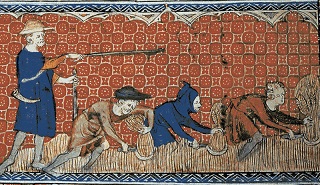
Reeve_and_Serfs
I think denial that climate change is serious is a later form of denial that climate change exists in the first place.  I am personally getting over denial that we have only a small chance of dealing with climate change.  I’m now on to planning for the future, of which more in a mo.

So, to NASA.  They have recently released a theoretical report about the common causes of the collapse of civilizations in the past.  It seems that you need to be consuming more of the resources than are available plus be divided into an “elite” minority and the poor commoners.  The report compares those situations with our own, and recommends that we reduce our consumption and inequalities.

Just what I’ve been saying.

So, what does that collapse look like?  I’ll take the Roman Empire as an example.  Before its collapse, it was characterised by a highly-organised and connected trade network, allowing production of commodities such as food in one part of the world to feed those in another, particularly to support large cities.  As law broke down, due to inequality and hyper-inflation, people became more insular and self-sufficient.  Land ownership became the true economy, and freedom and civil rights were lost.  Serfdom began.  Society went backwards and took centuries to recover.  The population dropped dramatically, due to war and the plague.

We have a highly organised and connected trade network.  We are over-consuming resources.  Inequality is increasing.  China is buying up masses of land throughout the globe, including here in the UK.  Aaah!

On a related note, the Transition movement, of which I am part, is actively moving towards a more insular, self-sufficient society, with local currencies, local energy etc.  Do we want this?  Or is it a case of survival of the fittest?

The NASA report is not all doom and gloom, and neither should I be.  Collapse is avoidable, if we drastically reduce resource consumption and find technological ways to continue to survive in a more equitable manner.  I have to admit – I’m not sure we’re built that way.

Anyway, come to Berkhamsted on 21 May to hear the optimistic view from Mark Stevenson, author of “An Optimists Tour of the Future”, when he comes to deliver the third Ashlyns Lecture.

John Bell

Ordinary Bloke

Conference Pair

I love it when a plan comes together.  After taking on a little too much before Christmas, not anticipating work taking off in January, I’m very happy to say that two of the initiatives are bearing fruit.  Not one, but two conferences are over the next few weeks.

The local Transition conference is now scheduled for Sunday 23 March, and we have our line-up.  If I’d had more time we may have been able to advertise it earlier, but it is happening, which looked a remote possibility just a few weeks ago.  Thank you to John Ingleby in particular for picking up the reigns.

It will run from 10 to 4, with workshops on starting an energy co-operative (we’re starting one in Berkhamsted), how to use gizmos like thermal imaging cameras, building community street-by-street, food security, personal resilience (I need this, getting run down) and scaling up the movement (we all need this).  All will be run by local Transition Towns, other than the personal resilience and scaling up workshops, for which we have Andrew Davies to thank.

If you are interested in coming along, you can book in here.

And not to be outdone, the Power Shift UK is in the diary.  This one really is for all of us.  It will be on the weekend of 3/4 May.  The theme will be connecting all of the disparate elements of the climate movement in the UK, particular to give voice to the down-trodden or marginalised in society.  The itinerary is not particularly confirmed at the moment, but is likely to include expert workshops on confronting oppression in organisations, practical skills in creating wind-turbines and training in the use of a new online platform created by the Stop Climate Chaos Coalition for the sharing of stories in the fight against climate change.  Huge thank you to Emily Myers, Susan Poupard, Claire Morris and to Fiona Brookes and the rest of the Campaign against Climate Change team.

Watch this space.

John Bell

Ordinary Bloke