The significance of Transition

May 2014 will mark the second anniversary of my first being elected Leader of Transition Town Berkhamsted.  It was and is a huge honour to be chosen for the post.  If I am elected again this year, it will be my final year in the post, as I have said that three years is the longest anyone should be Leader.  With that in mind, I want to ensure that the organisation is in as good a shape as I can before I make way for the next person, and so there are some conditions to my accepting any nomination this time around.

I believe that the work of Transition Towns over the planet is vital.

Not only does it allow us to break away from the malaise or frustration brought on from watching politicians convening to fritter away our future: it also means taking the necessary steps at home and in our towns to address the issues of climate change, resource depletion and inequality.

On a more pessimistic note, it means preparing for and safe-guarding against the potential collapse in society and our wellbeing that could result from these global issues, as we build local energy and food sources.

But the challenge is huge.  The number of people actively taking steps towards a positive future is small compared with the number who are carrying on, hedonistically but unknowingly doing everything they can to hasten the worst outcomes.

Over the past two years we have achieved an awful lot, with huge and important contributions from a number of different people.  With first the Positive Money talk with Fran Boait, and then the Ashlyns Lectures, we have established a method of putting on talks and attracting internationally renowned speakers that has allowed us to fund other activity.  The B-Hive has led to us raising our profile in the town, talking individually to over a thousand different people and garnering close links with local government and other groups, organisations and businesses.  There have been some gigantic steps on transport as well, from the edges of Transition, with the Safer Routes to Schools work.

This all feeds into our strategy of building community, linking groups in the town and pushing towards a widely adopted town plan that contains sustainability and resilience at its heart.

But, if we are to have any meaningful impact, we need to scale up towards critical mass.  The only way we can be successful is if we work together as a strong team, community and group of friends.  And that doesn’t mean one Leader upon which everyone can rely.

So, if I am to be Leader for 2014/15, I’m listing here what will need to be in place for me to accept any nomination.  Please discuss amongst yourselves to make sure it is all covered – you have under 8 weeks until the AGM (on 15 May).  Otherwise, I would be happy if someone else would like to put themselves forward as Leader.  Failing that, we will see how the organisation functions without a Leader in post.

On its own, this won’t be anywhere near enough to make the seismic changes we need.  But it is the minimum.

What I need:

  •          The Leader position will be renamed Chair, or some other piece of furniture that doesn’t imply being sat on comfortably.  It needs to be a consensus team effort and Leader goes against that in my view.
  •          At least one person needs to say that they would be happy to be Chair from May 2016, barring changes in circumstances.  This will allow us to transition.
  •          We need to share out the jobs.  That means the following roles need to be filled, with committed, enthusiastic people.  Details of the roles are available by following the links.  Most of this is covered at the moment already, but there are some gaps.  Above all, common sense will need to be applied.

o   Membership (currently Claire Mistry), Website / Facebook Administrator (currently shared between Marion Baker and Claire Mistry), Newsletter / Digest (new), Communications / Forum (new), Finance & Funding (currently Emma Norrington), Publicity (currently Bex Plenderleith), Ashlyns Lectures Co-ordinator (new) and Planning Socials / Inner Transition (new) plus points of contact for Energy, Food and Transport.

It might be preferable that a group of people pick up each role, so don’t be put off by one aspect.  Having said that, one person could do an entire role, or one person could even do more than one of them.  We can of course discuss if you would like to change anything – just get in touch.

I don’t intend on bashing people over the head with the role descriptions: I’m just looking to share the leadership responsibilities.  I do reserve the right to have what might become known as the “dreaded quiet word” now and again, though.

  •          We need to show that we are a buoyant organisation with dedicated members.  8 people need to commit to putting the dates of the Green Drinks in their diaries for the year of June 2014 to May 2015, and to prioritise holding the date, barring disaster.
  •          The Forum concept is the right one for communication, as it allows inclusivity; being selective as to what you read; and for structured conversation.  10 people need to commit to using the forum for all communication on Transition Town Berkhamsted, other than confidential discussion, but including information relating to activity tangentially related to TTB.  Note that the Communications role includes training people on the use of the forum and improving its usability.  Please reply to this topic on the forum if you are happy to be one of those 10 people.

I’ve added a new page to my website to keep track of these criteria being met.  I will not be chasing around to make sure that they are – that is up to you.

John Bell

Ordinary Bloke
 

The World as I would like to see it

In my last post, I said that Transition was moving to a more insular society.  I was wrong.  Transition is moving towards a society where communities are more self-reliant, that is true.  But not insular.  The realisation has lead me to muse about what the world would look like if Transition succeeded, at least my interpretation of it.  Read on MacDuff, and let me know what the world would look like if you had your way.

I’m dumping my brain here, so there are bound to be flaws.  I would welcome your feedback and recommendations to reading material.

The Transition movement and the like are often characterised by visions of sandal-wearing tree-huggers who would rather see everyone living in tepees than cosy indoors.  There is a grain of truth in that.  But it is very much a caricature to which most involved in Transition Towns would not aspire.

The world I would like to see remains connected, where the easy life is the norm.  It is possibly more inter-connected than we are now, but with less travel.  World society would be characterised by helpfulness between people around the globe and with nature rather than competition and exploitation.  There would inevitably be some people with more means than others, but all would help the needy in times of distress, such as when crops fail, disease or illness strikes.

Yes, communities would be more self-reliant for food, warmth and medicine.  There would also be a global sharing culture of ideas and expertise to improve everyone’s lives, rather than competing in the “Global Race”.

So, how would this be co-ordinated?  How would it be governed?  The way I see it, central governance is only needed to manage those activities and resources that are simply not possible at a community level.  We need more of that at the moment because our society is fine-tuned to live at the edges of our capabilities.  The population is as big as it can be for the amount of energy we can create and the food we can grow or rear.  We are utterly reliant on economies of scale to support the global population.  So, while we are building up the capability, skills, will and technology at the local level to support ourselves, we need government to provide that which we are unable.

At the moment, that central supply of services is not provided by government alone, it is provided by corporations as well, possibly to a larger extent.

But, once we have the ability to support ourselves locally, and with the connectedness of the internet to share ideas and ask for help, central governance from whatever angle would be less necessary.

I fully realise that is a bit of an idealised picture.  What if the internet broke down? What lazy good-for-nothings, leaching of the rest of us?  What if a group or person got ambitious and decided ethnic cleansing would be a good idea?

My vision does rely on us having adopted practices of food and energy production that require little effort to maintain, either through new technologies or through working with and alongside nature rather than against, such as edible forests or the farming practices described in the sample chapter of “An Optimists Tour of the Future”.

That would mean less time needed for the basics and the social constructs such as financial markets, and more for a flourishing culture, for art and innovation.  It would also allow us to turn to supporting others in times of need when evil set in and to maintain the internet.

So, where does that leave you?  Like it, loathe it, see the obvious flaws?

(A strange thing just happened.  Just after I wrote this piece I read the follow-up to the article I cited in my last post.  It reads as a more in-depth version of my own post, uncannily similar).

John Bell

Ordinary Bloke


So, you think I’m a bit mad?

I suspect you think I’m being melodramatic when I talk about society collapsing.  It might seem a tinsy bit far-fetched. I also think that the worse you think climate change is, the more they are likely to try to do something about it.  So I’m bringing in NASA to help outline my case.
Reeve_and_Serfs
I think denial that climate change is serious is a later form of denial that climate change exists in the first place.  I am personally getting over denial that we have only a small chance of dealing with climate change.  I’m now on to planning for the future, of which more in a mo.

So, to NASA.  They have recently released a theoretical report about the common causes of the collapse of civilizations in the past.  It seems that you need to be consuming more of the resources than are available plus be divided into an “elite” minority and the poor commoners.  The report compares those situations with our own, and recommends that we reduce our consumption and inequalities.

Just what I’ve been saying.

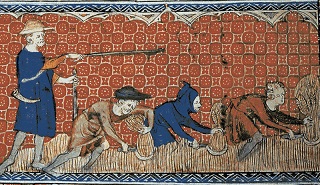
So, what does that collapse look like?  I’ll take the Roman Empire as an example.  Before its collapse, it was characterised by a highly-organised and connected trade network, allowing production of commodities such as food in one part of the world to feed those in another, particularly to support large cities.  As law broke down, due to inequality and hyper-inflation, people became more insular and self-sufficient.  Land ownership became the true economy, and freedom and civil rights were lost.  Serfdom began.  Society went backwards and took centuries to recover.  The population dropped dramatically, due to war and the plague.

We have a highly organised and connected trade network.  We are over-consuming resources.  Inequality is increasing.  China is buying up masses of land throughout the globe, including here in the UK.  Aaah!

On a related note, the Transition movement, of which I am part, is actively moving towards a more insular, self-sufficient society, with local currencies, local energy etc.  Do we want this?  Or is it a case of survival of the fittest?

The NASA report is not all doom and gloom, and neither should I be.  Collapse is avoidable, if we drastically reduce resource consumption and find technological ways to continue to survive in a more equitable manner.  I have to admit – I’m not sure we’re built that way.

Anyway, come to Berkhamsted on 21 May to hear the optimistic view from Mark Stevenson, author of “An Optimists Tour of the Future”, when he comes to deliver the third Ashlyns Lecture.

John Bell

Ordinary Bloke

Conference Pair

I love it when a plan comes together.  After taking on a little too much before Christmas, not anticipating work taking off in January, I’m very happy to say that two of the initiatives are bearing fruit.  Not one, but two conferences are over the next few weeks.

The local Transition conference is now scheduled for Sunday 23 March, and we have our line-up.  If I’d had more time we may have been able to advertise it earlier, but it is happening, which looked a remote possibility just a few weeks ago.  Thank you to John Ingleby in particular for picking up the reigns.

It will run from 10 to 4, with workshops on starting an energy co-operative (we’re starting one in Berkhamsted), how to use gizmos like thermal imaging cameras, building community street-by-street, food security, personal resilience (I need this, getting run down) and scaling up the movement (we all need this).  All will be run by local Transition Towns, other than the personal resilience and scaling up workshops, for which we have Andrew Davies to thank.

If you are interested in coming along, you can book in here.

And not to be outdone, the Power Shift UK is in the diary.  This one really is for all of us.  It will be on the weekend of 3/4 May.  The theme will be connecting all of the disparate elements of the climate movement in the UK, particular to give voice to the down-trodden or marginalised in society.  The itinerary is not particularly confirmed at the moment, but is likely to include expert workshops on confronting oppression in organisations, practical skills in creating wind-turbines and training in the use of a new online platform created by the Stop Climate Chaos Coalition for the sharing of stories in the fight against climate change.  Huge thank you to Emily Myers, Susan Poupard, Claire Morris and to Fiona Brookes and the rest of the Campaign against Climate Change team.

Watch this space.

John Bell

Ordinary Bloke

No help here, oh dear

So, we met with the UK Exchequer Secretary to the Treasury (Mr Tax), MP David Gauke.  As promised, we talked to him about shale gas and how its exploitation is incompatible with keeping global warming to less than 2º Celsius.  My conclusion after the meeting is that the current UK government will not back up its rhetoric with equivalent action – climate change will not be addressed.

The surgery was running late, so Danny Bonnett and I had a chance to practise our arguments beforehand, while sitting outside the Berkhamsted Town Council offices.  We would also mention the risk to our pensions that continued investment in fossil fuel exploration and extraction brings, as raised by the UK Environment Audit Committee recently.  We’d also discuss how the UK renewable energy sector is stagnating due to government planning policy.

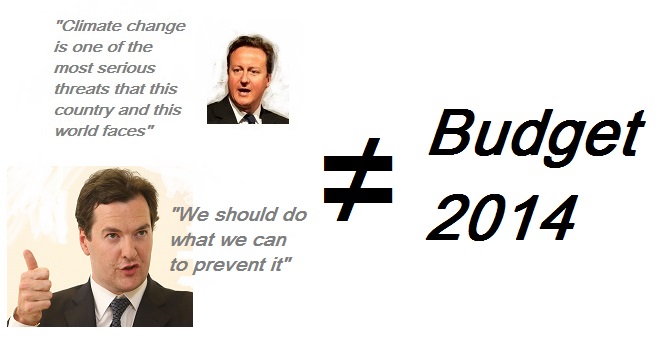
We then went in, got through the formalities and the conversation stated.  I read the recent quotes from David Cameron and George Osbourne that climate change is serious, man-made and something we should do what we can to address.  I stated the evidence that current targets gave us a less than 50% chance of avoiding the 2 º Celsius rise in temperatures.

David started by saying how the US has reduced its carbon emissions by more than anywhere else by moving over to shale gas.  He backed down from that argument after I pointed out that the US had a coal-based electricity generation network before they switched to gas, whereas we already have a gas-based system, so we won’t get the same benefits.  Plus we are starting 10-20 years later than the US – the remaining carbon budget is much lower now than it was then.

He did seem very interested in Danny’s first-hand accounts of how the UK renewable energy sector is on its knees at present due to uncertainty.

But his main argument for continuing with government policy was the need to keep energy bills down, particularly for businesses, and to do so in a way that was politically acceptable.  I.e in a way that would help them get re-elected.  Whereas shale gas is controversial, they think it is low-carbon (it’s not) and they think it is less controversial than onshore wind-farms.

They are evidently not going to take a strong stance to persuade the population that it is worth paying to replace our dirty power stations with renewable energy.

So, where does that leave us?  For meaningful action on climate change, at least a couple of Business, Government, Media and the Public need to make seismic changes to change our attitudes and to reduce our greenhouse gas emissions.  I know some think that they are within their moral rights to live as they please, and there should be incentives in place to make sure that our actions are acceptable to society.  Or that there is no point in making changes in their lives if the majority do not do similar.

Well, the Government is not going to bring in those incentives.  The media continues to serve all opinions on climate change, whether scientifically valid or not, so the public will be able to find a way to justify denying the problem or that they can be part of the solution.  Business will aim for profit, and the Government will not be incentivising sustainable practices to a large enough extent.

So, the only way through is a revolution.  Society as it stands cannot cope with climate change.

Or get those kids trained in survival skills.

Or maybe we all need to take responsibility for our actions, and reduce our own emissions.

John Bell

Ordinary Bloke

Here we go again, another press complaint

Encouraged by the results of my survey, I am embarking on another press complaint.  I know I said that press complaints appear to be very difficult to be upheld.  I also said I wouldn’t draw wild conclusions from the small, biased sample that my survey represents.  Hey ho.

The survey indicated that once you are over your denial of climate science, the amount of change you are willing to make to reduce your impact is correlated with how bad you think the outcomes will be.  Phew, that is a wild conclusion given the survey was unscientific, small and biased.  But it makes logical sense, so I’m running with it.

So, less contrary and inaccurate bilge in the press, less for people to hang their denial hats on, more chance of progress.  I’m not sure the logic follows either.

But, we’re going for it anyway, for the last time maybe.

The experiment this time is whether a clearly inaccurate statement gets retracted.

Thank you to Graham, who has both pointed out the article and done the research.  The target is an article in the Express in the UK by Leo KcKinstry, with the headline “Global warming is about hotter, drier weather … not flooding“.

There is an awful lot that is wrong about the article, but we decided to go for the two most obviously inaccurate statements.  The following is the first email to the Express:

Dear Sir/Madam
 
I would like please to draw your attention to two inaccuracies in the recent article “Global warming is about hotter, drier weather … not flooding” by Leo McInstry in the Express on 13 Feb.
 
I hope you will publish a correction?
 
Firstly, the headline is inaccurate.  Global warming is about flooding.  Please see the following extract from the IPCC report:
“Changes in many extreme climate events have been observed since about 1950. It is very likely that the number of cold days and nights has decreased and the number of warm days and nights has increased on the global scale. It is likely that the frequency of heat waves has increased in large parts of Europe, Asia and Australia. There are likely more land regions where the number of heavy precipitation events has increased than where it has decreased. The frequency or intensity of heavy precipitation events has likely increased in North America and Europe. In other continents, confidence in changes in heavy precipitationevents is at most medium.”
 
Secondly, the article states “In fact in the last century in Britain there were four winters with heavier rainfall”.  This is not true.

The UK has had the wettest winter (517.6mm of rain fall) since national records began in 1910, the Met Office has confirmed.

John, Graham

So, climate change is real – what next?

Danny Bonnett and I are meeting David Gauke, the UK minister for tax, on Friday.  In the context of recent affirmations on the reality of climate change from the leadership of the Conservative party, we will discuss with him the policy implications, particularly for shale gas or fracking.  The following is what we intend to say:

David Cameron and George Osbourne have recently stated that climate change is man-made and that we should do what we can to prevent it.  We are faced with a choice between either leaving shale gas in the ground or with missing international pledges to limit temperature increases to 2° Celsius.  What will the government choose?

David Cameron, UK Prime Minister “I believe man-made climate change is one of the most serious threats that this country and this world faces”.

“I’m someone who believes climate change is happening, that it’s caused by human beings. We should do what we can to prevent it” George Osbourne, UK Chancellor of the Exchequer.

According to the science, current climate change targets in the EU would lead to a 30-50% chance of keeping temperature rises below 2° Celsius.

To me, “doing what we can to prevent it” does not equate to aiming for a 40% chance of success.

Put simply, if we are to back up these words and commitments with action, shale gas production cannot happen in the UK, even with carbon capture and storage.  At the point when shale gas production in the UK would be becoming large scale, we would have to stop, leaving wells only partly tapped.  Investment in shale gas would also delay investment in very low or zero carbon sources, leaving a huge legacy for future generations.

Achim Steiner, head of UN Environmental Programme “We sometimes have to take a step back and ask ourselves: for the sake of having another 20 years of dirt cheap energy are we really going to put millions of years of evolution, of ecosystems, of ecosystem services at risk?”.

I agree with George Osbourne when he states “Let’s try and do this in as cheap a possible way as we can”.  The cheapest way to tackle climate change is to invest now in zero or very low carbon energy.  The sooner we make this move, the lower the overall costs, as Lord Stern described in his report in 2007.  If we want to continue to revitalise the economy, let’s do it in a way that creates skills and jobs that are relevant for the future.

John Bell,

Ordinary bloke