But is this idyllic life worth it?

If ordinary folk around the UK and the West spent a lot more time at home and with family and friends and less time buying crap and travelling, the climate crisis would be largely solved.  I’ve made the change and am loving it.  How does that lifestyle play out in the numbers?  Is changing to my idyllic life worth all the effort?  And how guilty should I feel about having thrice sprogged?

I’m talking greenhouse gas emissions here, the driver of man-made climate change, not money – my outgoings are drastically lower than they were, but that’s another story.

According to carbonfootprint.com (I got a similar total using the simpler calculator on the WWF site, but with less of a breakdown), my annual emissions break-down as 0.85 tonnes of CO2 on gas & electricity; 0.87 tonnes on petrol; 0.19 tonnes on the train; 1 tonne on owning a car; and 1.28 tonnes on “other” (including having a bank account – 0.4 tonnes and eating animal produce – 0.5 tonnes).  Total is 4.2 tonnes per annum, against the UK average of 9.8 tonnes.  I would be interested in what yours looks like – you need your annual gas & electric figures plus your annual mileage – settle down with a cup of tea and work through the site, doesn’t take very long.

But what about the elephant in the room – my kids.  At the moment, they each cause about 0.44 tonnes per annum in addition to the above.  But that will change as they become adults.  What would my emissions look like if I took complete responsibility for all of their emissions, because Rowan and I took the decision to procreate?

So I did a few simple calculations, and came up with the following graph of my cumulative emissions.  This doesn’t include me using Ecotricity* to buy the electricity off the grid (51% of their electricity is generated from renewables).  Is does assume that emissions are coming down in general, and doesn’t include the emissions of grandchildren.  I reason that these effects probably offset one another.
Graph cumulative tonnes CO2
What does it tell me?

First is that the most important thing I can do over the next few years to reduce my own emissions is to impress on my kids the need to look after their world – it will save about 100 tonnes if they act as I do rather than the average in the UK.

Secondly, I can feel a little less wracked with guilt about the children because if they do adopt a lifestyle like mine my and their emissions combined will total less than that of an average single UK resident of my age.  And if you include the average UK resident having an average number of average children, then our emissions will be less than half of theirs.

Then there is the question of carbon offsetting – where you pay someone else to put in place some scheme that reduces emissions to compensate for your own.  This could be building more renewable energy stations, for example.  I invested in an avoided deforestation scheme, where an area of rainforest that was due for the chop was saved, offsetting 100 tonnes.  If you include that, then my overall emissions including the children is less than 100 tonnes in our combined lifetimes, compared with an average in the UK of 380 tonnes.  This is controversial, because of double-counting – would the scheme have gone ahead whether or not I invested?  And is it a get-out-of-jail card for everyone – is there enough capacity that if everyone offset their carbons we’d be home and dry?

I think that if the top 1-5% of emitters, roughly speaking those who earn £30K or fly once a year or more, adopt a lifestyle more like my own, devastating climate change would be avoided.

Would you like to be part of the solution?  How can I help you?

John Bell,

Ordinary bloke

* Ecotricity have recently been able to change their tariffs so they can offer gas & electricity at a rate cheaper than the Big Six.  They also invest on average £280 per customer in building new renewable power stations.  They can do this because renewables are getting cheaper, whereas fossil fuels are not.
My Life

So, John, what do you mean by a low carbon lifestyle?  Sounds like austerity gone mad.  Must be very boring.  How about I tell you?

Most mornings, I get up early, leaving my wife snoozing in bed and the baby snoring in the cot.  Sometimes, my eldest daughter Maddie has woken up early as well, and has been reading in bed.  I get her started with her breakfast, before heading out for a jog into the woods.

Early morning

Early morning


I sit for a few minutes under a tree, enjoying the sounds of the natural world, before jogging back home for eggs on toast and a cup of black coffee.

Then there is a little frenetic activity as we get the children up and ready for school.  Occasionally I accompany Maddie and Emily on their walk to school, sometimes my wife Rowan has the honour.  If it’s me, it’s likely I’ll be walking back via a farm shop to buy some locally grown eggs and veg, which are cheaper than the supermarket.

Walk back from the shops

Walk back from the shops

I’ll then settle down at home for a day of work, powered by the sun on my roof. That will be a combination of work for my business, organising things for the Transition Town or Global Power Shift, or maybe illustrating or writing if I’m feeling creative.  On the odd day I’ll get the train into London to meet with my business partner or a client.

I might help myself to the odd cup of tea or biscuit during the day, and lunch is a relaxed affair with Rowan and the baby.

Up to twice a week, I walk into the town rather than work from home.  On those days, I work from a friend Bridget’s loft.  We swap skills – she helps me with my writing, I help her get her computer glitches sorted out.  On the walk back home, I might go to the local butchers to pick up some ham or sausages.

While I’m out and about, I might spend some time on the allotment digging, harvesting or weeding.  I don’t do as much of that as I should.  I can catch up with work in the evening if I decide to spend more time outside during the day.

I’m then home early to help with an early evening meal and to get the children to bed.  A few days a week I might go out to a meeting in the evening over a glass of wine at someone’s house, or over a pint in the pub.  Red Squirrel or Side Pocket are decent.  On other days I might watch a film with Rowan, or catch up about the day.

Out and about - with the Snake Tree

Out and about – with the Snake Tree


The weekends are similar to the weekdays, but with the kids around.  We’re likely to go for a walk / bike-ride in the woods, or go up to Whipsnade for a little while (this involves the car).

For holidays, we might go up to my folks on Anglesey in North Wales or up to the in-laws in Shropshire.  This year we also went to what proclaimed to be a low-carbon cottage in the Cotswold Water Park, just south of Cirencester, for a week of sun, swimming, tennis and scones.

Holidays - James with Aunty Lau

Holidays – James with Aunty Lau


How does that sound to you?

John Bell,

Ordinary bloke

Are you a muppet?

I’m now convinced of what needs to happen to avoid a terrible future.  Read on for my summary and why I think that future is almost assured, because you’re all idiots.

First up, climate change is happening and we are the cause (this time – yes, it has changed naturally in the past).

If we don’t sort it out fast, we’ll be living in a world with far fewer species and where our food supplies are diminishing, at the point in history when the world’s population is at its peak.  The hungry may just lay down and die.  They may not.

Something really should be done about it, or our idyllic, carefree lives will be ripped asunder, and our green and pleasant land will be no more.

Even if policies were such that we were to start a real decarbonisation now, it would take too long.
Apocalypse_vasnetsov
1-5% of the global population account for 40-60% of emissions.  The only way emissions can come down quickly enough is if that 1-5% change their habits drastically now.  The 1-5% are you and me.

But we are all addicted to carbon.  To kick our addiction, we will have to go through the emotional barrier of accepting that we have a problem and we do need to change.

So do you think the state should intervene and force you to change?  Or would that be an example of the nanny state – you should be trusted to do the right thing.  Or at least you should be trusted but only if you have a little chivvying along.

I don’t think you will, because I think you are all a bunch of muppets.  Prove me wrong.

I’ve found that my life is better after reducing my carbon emissions, so I’ll continue describing how I am doing.  It’s up to you to try to do the same.  Get help from your local Transition Town.  Let me know how you get along.

John Bell,

Ordinary bloke

Tax, Morals & The Solution

We should have the freedom to make our own choices about how we live.  With that freedom comes responsibility.  Responsibility to act fairly and morally.  How do you know whether you are acting with fairly and morally, and do you have that freedom?  It is a fundamental issue when it comes to what we should do about climate change.

I think that we should treat each other as we would treat our own family and how we would expect to be treated in return.  That means everyone, wherever they happen to live or were born, around the world or in what year, past, present or future.  Someone who was born in 1920 in the US or in 2045 in Bangladesh are equal to you, to me and to each other, and should be treated as such.

Your rights are important.  Should you consider the impact on anyone else who could be affected each time you do anything?  How can you possibly know what those impacts are?  You’ve got to be able to get on with your life.

Some would say that the law is there to guide you – as long as you act within the law, you are acting fairly and morally.  Maybe you could add to that the monetary and tax system – as long as you are making a balanced judgement as to whether your benefit is worth the cost of an action, then you are acting fairly.  You wouldn’t shaft someone on a deal, even if it was within the law, if it meant your relationship or reputation would be damaged.

So, with that as context, back to climate change.  I talked about changing the law in the last post.  If that is too restrictive, then how about changing the tax system instead?  How about a tax on the emissions at the point that greenhouse gases are emitted, in proportion to the future monetary and environmental cost?  A tax where the revenue from the tax is given out to everyone equally, as a universal allowance?  The cost of the tax would be added to transport fuel and to the cost of generating electricity.  It would be added at source if emissions are required to get at the fossil fuels in the first place, such as with tar sands in Canada.  The cost of the tax might then be passed down to consumers, who would then either gain overall (if they were careful in the impact of their lifestyle and purchases) or would lose out if they were more reckless.Tax-as-moral-issue

Sounds fair enough, do you think?  Difficulty would be that it would need to be adopted globally to work, otherwise you would just import your electricity or buy products from aboard where the tax was not in place.  To get around that in any particular country, such as the UK, you could add it as an import tax as well as a tax within the country borders.

Hmm, maybe.  Hang on, though, John – are you just suggesting this because you want the tax break?

Actually, no.  Whereas I think such a system would be a huge leap forward and if adopted widely would potentially get us out of the hole, I can’t see it coming in soon enough, if at all.

What should we do in the meantime?  Should we be able to do what we want within the law and within the current tax system?  If only a few nutters like me have stopped flying, it’s not worth making the sacrifice until the law or tax system changes.

Do you think?  Do you really think so?  Is it fair and moral, without a change in the law or tax system, for you to prioritise your own luxury and comfort over the basic needs of my children and grandchildren, and of people living in Bangladesh now and in the future?  What about our heritage, of the glorious abundance of beautiful flora and fauna, sadly diminishing fast?

John Bell,

Ordinary bloke

Regulation’s what we need if we don’t want to be a temperature record breaker

The only way we can avoid truly devastating climate change is if you and I and everyone else like us radically reduces consumption and energy use and does it fast.  It’s as simple as that.  But also as difficult.  What needs to happen so you will stop flying, drive less and eat less meat?
SONY DSC
Some people are calling for governments to introduce incentives or regulation.  It could be lowering the legal limits for emissions from car exhausts, or from power plants.  Maybe it would be a legally binding promise to decarbonise the energy sector in a certain timeframe.

Those on the left of the political spectrum* are more likely to think that the above steps all sound very sensible, even that they are no-brainers.

If you are on the right, though, you are more likely to think that those kinds of measures smack of the nanny state.  Why should the government intervene in our lives to such an extent?  Surely we should be trusted to do make our own choices and take responsibility.

That being the case for you, then you’ll obviously be taking major steps to reduce your carbon emissions, right?  I don’t need to explain what I mean by that, because you’ve already done your research and are well on the way.  You carbon footprint has gone down by 20% already.  You trust that everyone else will be doing the same.  The markets will adjust to the realisation of the long-term risks and will help bring about the rate of change we need – it doesn’t need additional regulation…

Hang on, I’m not going to do any of that if no-one else is, you might say.  I want to take responsibility for my own choices, but it’s not fair unless everyone else does the same.

So does that mean we need the regulations or not?  Or maybe we need the tax set-up to change so we are all incentivised to make the changes necessary?  We’ll talk about that in a future post.

Climate change represents the greatest ever test of right-wing political ideals.  Not because it has been invented by left-leaning hacks (it hasn’t).  It’s because without regulation and an effective carbon market, emissions are going up, and the rate that they are going up is increasing.  People are not changing their behaviour, they are becoming more entrenched in their denial.  It is likely that you are not taking drastic steps yourself to reduce your emissions.  You’ve probably not even calculated your carbon footprint.

That is why right-leaning politicians and public are much more likely to deny the science than those on the left.  80% of UKIP voters deny climate change – it’s the same pattern in the US.  That’s because it doesn’t look soluble if you stick to the principles of the right alone.

Don’t get me wrong – markets and business may be a large part of the way out.  Even big business such as Shell realise and would welcome a stronger government hand in helping change conditions so they can be part of the solution rather than the problem.

So, what would get you to change your behaviour?

John Bell,

Ordinary bloke

* If you know whether you are left or right leaning, then stop reading this footnote – you’ll probably find it condescending.  If you’re not sure or are but are interested in an online test to get it verified, then try the Political Compass.  I used to come out slightly closer to the centre than Ghandi.

I Blame the Parents

Is it our increasing population that is really to blame for climate change?  Should we be focusing our efforts on reducing the birth rate rather than the emissions of those already alive?  This is a difficult one for me, with a young family of three, but I will remain objective and see where it leads – please bring me up short if I stray.

An expert in the field of forecasting long term trends, who happens to be an employee of a large oil company, suggested during a public debate that 40% of future increases in greenhouse gas emissions are expected to result from a growing population, with the other 60% from lifestyles.  On those rough figures, it would seem that the answer is a bit of both.

Logically, there wouldn’t be a problem if the human population was a lot lower – emissions would go down proportionally and more so with fewer people developed nations.  The problem would also largely go away if everyone adopted simpler, less destructive lifestyles.  A large population would still have a significant impact, though.

So what should we do?  I feel the need to look at a few numbers.

What would happen if we went to the extreme and banned all new births?  No one is suggesting we do – I’m just taking it to an extreme.  I’ll concentrate on the western world, in fact the UK, as I’ve got some numbers to help me.  Cautionary note – take these numbers as back of the fag packet calculations – I’m doing them to get a picture, nothing more.   They ought to be in the right ball-park.

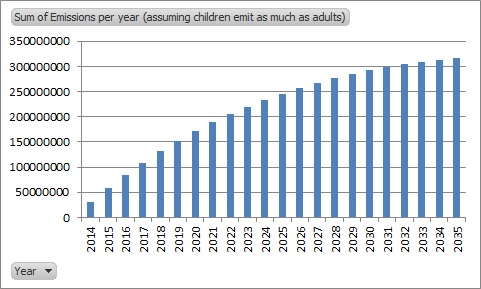
According to the book “How Bad are Bananas?” by Mike Berners-Lee, the average child born now is expected to be responsible for 373 tonnes of carbon dioxide emissions in their lifetime.  According to UK government projections, there are expected to be 1,100 births per 1,000 women from 2014 to 2030 [no, must have misinterpreted the ONS site – less than half that – thanks to Stewart for pointing out in comments below – other figures below have been corrected accordingly].  Over that period, there will be about 67 million people in the UK on average, so about 33.5 million women.  So about 15 million births.  By my rough calculations they would be responsible for about 4 billion tonnes of CO2 over their lifetimes, of which 1.3 billion tonnes will be emitted by the end of 2030.  That’s of a total of 10.8 billion tonnes for which the UK is expected to be responsible over the same period.

So we could reduce our total emissions by 13% if we stopped all births over that period.  Of course we wouldn’t stop all births, that would be crazy.Emissions per year kids from 2014

So how about reducing the birth rate so the average number of children per family was 2?  It’s only slightly over 2 at the moment, so that would have very little effect.  Roughly speaking, reducing the number of children to one per family would save about 7% of UK emissions.

These numbers all assume that the UK will decarbonise the energy sector by 80% by 2050, according to its international agreements.  They also assume that children are as responsible for as much carbon dioxide as adults.

So, from a carbon emissions standpoint, it is worth trying to reduce the birth rate.

But it certainly wouldn’t solve climate change.  And it would reduce emissions anywhere near quickly enough.  The only way to do that is to stop using as much fuel and energy now, by our lifestyle choices.

John Bell,

Ordinary bloke

Have you Been Misled?

What you think you know about climate change could be bollocks.  You might hear the voices of those with a vested interest in the status quo say that climate change is a swindle, a hoax, made up by the political left and scientists looking for grant money and propagated by the gullible environmentalists.  Rubbish, of course.  No, the real misinformation is about how much time we have to get the carbon out of our system.  In reality, you’ve got time to solve the problem, but not to wait for “them” to give you a hand.increase-profit

Kevin Anderson of the Tyndall Centre spelled this out in no uncertain terms in the Cabot Institute Annual Lecture of 2012 “Real Clothes for the Emperor” in Bristol.

The scientists that turn the jargon-ridden scientific papers into something useful for policy makers, business and public alike have been overly optimistic.  They’ve fallen into that all-too-human trap of wanting to please.  It’s not the science that has been misrepresented, but the part of the system most difficult to predict – the reaction of humanity.

I’ve seen the same happen in business profit projections or forecasts of project spending when the proverbial shit is hitting the proverbial fan.  Not wanting to be the unfortunate harbinger of bad news, managers account for all of the myriad of initiatives that have been conjured up to improve the situation and ignore the potential downsides.  They may still end up with a little bad news, but it looks manageable, under control.

That was one of the reasons I wanted to get out of permanent employment as a project manager.  I’d taken a more pragmatic and realistically honest approach, which had then got watered down and politically finessed before reaching the upper management, who were all to ready to subtly point the finger, or allow those below them to do so.

So I can see how it has happened with the projections for climate change.  Kevin Anderson looked at the forecasts in a cross section of scientific summary reports and showed where the heroic assumptions have come in.

Their assumptions about the now are bad enough.  They often start with a level of emissions lower than reality.

Then it gets really silly when you look at the future.  Most reports upon which policy makers rely assume that global emissions will peak in 2014 to 2016, where in reality the rate they’re going up is going up.  Then they assume that emissions will go down at an incredible rate.  So fast in fact that if you make realistic assumptions about the rate of decrease of emissions in the developing world, then the developed world would have to abruptly, suddenly stop all greenhouse gas emissions in 2015.

The lesson?  We cannot rely on “them” to replace our electricity supplies with emission-free alternatives quickly enough – it just isn’t feasible.  We cannot rely on “them” to invent a way of making our cars or planes move without damaging the future.

The only way that we can get out of this mess is if those people who possess the solution prioritise the future for our children above their own luxury.  That’s the 1-5% of the global population responsible for the majority of emissions, the people who earn £30K or more or fly once a year.  That may well mean you.

To enact the solution might look like making sacrifices, like stopping flying or travelling less.  In my experience life is a whole lot better when you make the change.  I’ve got so much more time for my family, Britain is beautiful and the company of friends life-giving.  Let’s enjoy real Life.

The next couple of posts will discuss how that might come about.

John Bell,

Ordinary bloke

A Confession

This is a very personal post.  I am bearing my soul to you: letting you in on a secret.  I have an addiction.  I’ve been in denial and am now in a place that I can write about it.  I still don’t really believe it.
Tongue in Cheek
The good news is that my addiction is manageable, and nowhere near as bad as it can get.  The bad news is that it is potentially terminal, and particularly harmful to those closest to me.

The acronym I have found and used that helps me realise that I have a problem is CAGE.  It stands for Cut Angry Guilty Eye-opener.  It is a reminder of four questions – if you answer Yes to two of the four, then there is a chance you are addicted.

Yes – I do feel as though I need to Cut down.  Thankfully, no – I don’t get Angry if someone points out the problem.  Yes – I do sometimes feel Guilty.  No – I don’t show symptoms of an Eye-opening addiction behaviour, such as driving round the corner when a walk would be only slightly longer.

What?  Driving round the corner?  What’s he on about?

The addiction I have is to carbon use.  I’m almost certain that you have the addiction too, even though we both know that our mental and physical health is suffering and the long term damage is unspeakable.  If you don’t accept this, there is a strong possibility that you are in denial.  If you get angry at the accusation (or for example if someone tells you not to fly abroad for a holiday or to switch off your lights or car) then see the “A” in CAGE.

I can’t seem to kick the habit.  I still get on the computer or phone regularly – I can’t seem to stop myself.  There is no way I seem to be able to make a meal or sandwich without including meat or cheese if there is some available.  It’s an awful temptation to get in the car  to take the kids swimming rather than learn how to ride a bike properly.

I’ve found a very useful website that can help, to diagnose, help with understanding and provide tips on how to break the habit.

Sorry to have to break it to you like this.

John Bell,

Ordinary bloke

Dark

This is the first of a short series of posts on the state of the world and how we can avoid catastrophe, or not.  This one may be the most important.

I quote verbatim from the Sir Tom Stoppard morality drama Darkside, written to celebrate the 40th anniversary of Pink Floyd’s The Dark Side of the Moon.  Thank you to Graham for alerting me to its existence.Moon

“So woe to you.  Oh woe to you and me.  And woe to all of us.  But we can save the earth from turning to dust and bones.  Dust and bones; from fire and flood.

Look here’s the thing.  Here’s what I’m saying.  The Earth is the common.  You can’t save it for yourself, but you can save it for others.  And the others will save it for you.  The other is us, and we are the other.  We are of a kind.  We are natural born to kindness, which means to act as to our kind, as kin to kin, as kindred, which is to act kindly.

What is the good?  It’s nothing but a contest of kindness.  To be unkind is against nature and it makes us feel bad.  To be selfish is against nature because it is against our kindness.

We are as natural born to unselfishness as a mother to her baby.  Her milk is the milk of human kin and kindness.

But when we live for trickery and gain, we turn against nature.  And nature will turn against us.

We will be lords of dust.  And bones.”

I’ve not asked for permission to put this up – I’ll take it down if it causes a problem.

The full play is well worth a listen if you can listen for about 50 mins.  It’s only on BBC iPlayer until 2 Sept.

So who has the solution?

So who does have the solution to climate change? The answer is surprising.

Rather than try to find the person or people to blame and vilify about what we have done and continue to do to exacerbate the problem, might it be more fruitful to look for the group of people who are most able to get us out of the hole?

If we’re thinking about a technological solution, then it could be any one or more of a number of scientists, inventors or entrepreneurs.  How about a solar greenhouse?  Or farming practices that capture carbon dioxide?  Trouble is that the world is a big place with a lot of people in it – and it takes time for new technologies to roll-out, especially on an industrial scale as would need to be the case.
Your Country Needs You
Technology will probably be part of the solution, but probably not quick or comprehensive enough (too little, too late).  So who else?

We could look at who has the power to decide how much of the different greenhouse gases to emit.  Of course, that includes everybody, to a greater or lesser extent.  If you walk over to the light switch and switch it on or off, you are creating or stopping some emissions.  So we can all reduce the emissions for which we are responsible.

But let’s look at those who have the greatest sway on the level of emissions.

It is the way of the world that power is always concentrated among a tiny minority.  By applying the 80-20 rule three times, scientist Kevin Anderson showed that 40-60% of emissions are the responsibility of 1-5% of the global population. These super-rich have the keys to the solution for climate change.

But just who are these super-rich?

Turns out that in western terms, super-rich doesn’t seem that wealthy.  If you earn £30K or more per annum or fly once per year, it’s you.

It’s you.

John Bell,

Ordinary bloke